U.S. Energy Information Administration logo
Skip to sub-navigation
February 15, 2017

EIA’s short-term global oil demand outlook considers the role of economic activity
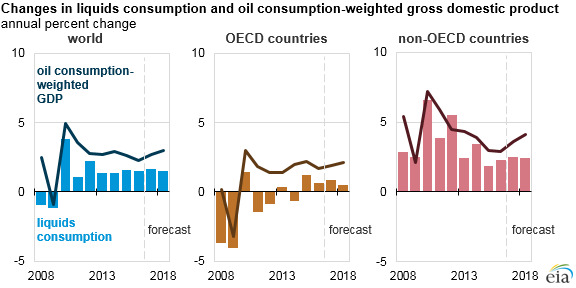
graph of changes in liquids consumption and oil consumption-weighted gross domestic product, as explained in the article text
Source: U.S. Energy Information Administration, Short-Term Energy Outlook, February 2017
Note: OECD is the Organization for Economic Cooperation and Development.

Oil plays a crucial role in the global economy—from the production of goods to the transportation of people and freight. For this reason, economic activity and oil consumption tend to move together, particularly in developing economies. This relationship makes gross domestic product (GDP) an important driver of oil consumption.

In developing its Short-Term Energy Outlook (STEO), EIA considers measures of economic growth that reflect whether growth is disproportionately occurring in countries that consume a lot of oil (with respect to their total economic output) or in countries that consume relatively little oil.

In addition to a GDP forecast for the United States, EIA uses an economic growth forecast weighted by levels of oil consumption for the Organization for Economic Cooperation and Development (OECD) region, for the non-OECD region, and for the world. An EIA working paper provides additional explanation of the methodology for the STEO’s oil consumption-weighted GDP.

A potential shortcoming of using an aggregate oil consumption-weighted GDP growth rate as an indicator of world oil consumption growth is that it does not account for differences across countries in the sensitivity of oil consumption to changes in economic activity. The elasticity of oil use to GDP, a measure of the responsiveness of oil demand to changes in economic activity, tends to be larger for emerging economies (i.e., non-OECD countries) than for advanced economies (i.e., OECD countries).

Principal contributor: Laura Singer

Statistics
Analysis
Tools
Education
News

Petroleum & Other Liquids

Crude oil, gasoline, heating oil, diesel, propane, and other liquids including biofuels and natural gas liquids.

Natural Gas

Exploration and reserves, storage, imports and exports, production, prices, sales.

Electricity

Sales, revenue and prices, power plants, fuel use, stocks, generation, trade, demand & emissions.

Coal

Reserves, production, prices, employment and productivity, distribution, stocks, imports and exports.

Nuclear & Uranium

Uranium fuel, nuclear reactors, generation, spent fuel.

Renewable & Alternative Fuels

Includes hydropower, solar, wind, geothermal, biomass and ethanol.

EIA Survey Forms

Forms EIA uses to collect energy data including descriptions, links to survey instructions, and additional information.

Total Energy

Comprehensive data summaries, comparisons, analysis, and projections integrated across all energy sources.

U.S. States

State energy information, including overviews, rankings, data, and analyses.

International

International energy information, including overviews, rankings, data, and analyses.

Environment

Greenhouse gas data, voluntary reporting, electric power plant emissions.

Data Tools, Apps, & Maps

Tools to customize searches, view specific data sets, study detailed documentation, and access time-series data.

Open Data

EIA's free and open data available as API, Excel add-in, bulk files, and widgets

EIA Beta

Come test out some of the products still in development and let us know what you think!

Open Source Code

EIA's open source code, available on GitHub.

RSS Feeds

Subscribe to feeds for updates on EIA products including Today in Energy and What's New.