
Mid-Atlantic electricity market reacts to Tuesday's earthquake
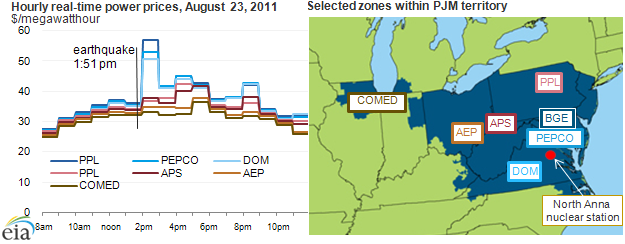
Note: PJM provides a complete map of pricing zones (choose the zone option). Location-specific prices are set every 5 minutes. The prices above reflect the average of all 5-minute prices in a given hour.
Download CSV Data
A magnitude-5.8 earthquake centered in Mineral, Virginia on Tuesday, August 23, 2011, had relatively minor effects on the energy industry. However, it did cause nearly 2,500 megawatts of electric generating capacity to trip offline, including two nuclear reactors, in the Virginia territory of Dominion Power. Average hourly real-time prices for the hour ending at 3:00 p.m. in the Baltimore Gas and Electric, Pepco (serving the Washington, DC area), and the Dominion regions jumped to between $50 to $60 per megawatthour (MWh) after the event.
Prices separated from other PJM pricing zones by $16 to $20 per MWh (see chart above) probably because higher-cost, quick-start generating units initially replaced the lost generating capacity. Price separations subsided as lower-cost units ramped up to replace the lost supply. PJM Interconnection is the electricity system and wholesale market operator in the Mid-Atlantic.
As reported on August 23 in the Department of Energy's Office of Electricity Delivery and Energy Reliability's Energy Assurance Daily (EAD), Tuesday's earthquake resulted in the automatic shutdown of Dominion Resources' two reactors at its 1,842-MW North Anna nuclear power plant in Louisa County, Virginia, when the plant lost offsite power. No significant damage was reported at the station, and there was no release of radiation. Return to full power operations at the plant may take several days while the plant is inspected for potential signs of damage.
The EAD also reported that twelve other nuclear power plants declared unusual event occurrences, although their operations were not affected. Several other non-nuclear power generators along the East Coast were tripped, meaning they were automatically shut down by the seismic event.
Effects of the earthquake were limited in the oil and natural gas markets. Some pipelines in the vicinity of the epicenter, such as the Colonial system that transports petroleum products, temporarily shut down for inspection due to the seismic activity, only to be restarted by late Tuesday evening.
Tags: electricity, generation, nuclear