
EIA provides daily summary of Southern California energy conditions
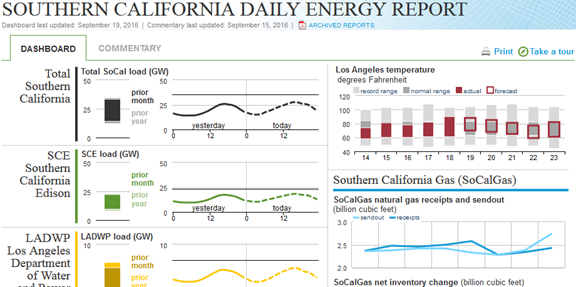
The U.S. Energy Information Administration now provides a report with daily information on Southern California energy markets, the Southern California Daily Energy Report, to help give context to the Aliso Canyon natural gas storage situation. On October 23, 2015, Southern California Gas Company (SoCalGas) detected a major leak at Aliso Canyon, an underground natural gas storage facility located 30 miles northwest of Los Angeles. Its 86 billion cubic feet of working natural gas capacity accounts for about two-thirds of SoCalGas' natural gas storage capacity, with deliverability estimated at 1.9 billion cubic feet per day (Bcf/d). Although the leaking well has been plugged, continuing limitations on the use of Aliso Canyon change the way both electricity and natural gas can be managed to meet energy demand in Southern California.
EIA's new report uses several data sources, including EIA, SoCalGas, the California Independent System Operator (CAISO), and the National Oceanic and Atmospheric Administration (NOAA). In addition to data updates each business day by 10:30 a.m. Eastern (7:30 a.m. Pacific), the report will provide occasional market updates and links to other information resources.
During the summer, the major challenge in energy systems management in Southern California is meeting electricity load. The report provides a consolidated view of hourly load across Southern California by combining long-available CAISO information for Southern California Edison Company and the San Diego Gas and Electric Company with data from EIA's new hourly power data report for the Los Angeles Department of Water and Power and the Imperial Irrigation District. The report also provides recent and forecast daily temperatures in downtown Los Angeles, the most significant driver of energy demand.
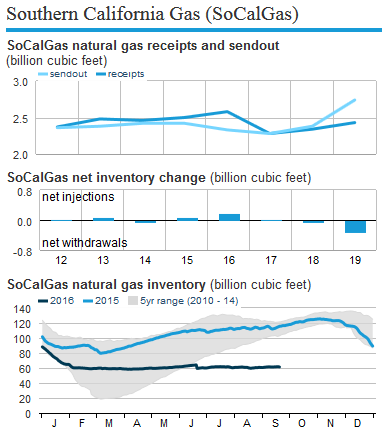
Natural gas generation is a key component in meeting electricity demand across all of California, supplying about 40% of statewide electricity load over the past decade. In June, the California Public Utilities Commission placed limitations on the use of the Aliso Canyon storage facility, which have reduced flexibility in meeting customer requirements in Southern California. SoCalGas may withdraw limited amounts of natural gas—up to 5 billion cubic feet over 14 days—from Aliso Canyon as needed to meet system needs, but SoCalGas may not inject natural gas into Aliso Canyon storage under current restrictions.
Increased hydroelectric and solar photovoltaic generation, recent growth in wind generation, and abundant power imports have reduced historical pressures on natural gas demand in California so far this summer. As summer heat becomes less of a factor in late September and into October, winter natural gas load, which includes natural gas used for heating, becomes the next seasonal challenge. EIA's report monitors daily changes in storage inventories in SoCalGas's four storage fields in the Los Angeles basin and compares the current status to the level last year at this time and to the previous five-year range.
The metrics shown in the report may evolve as EIA highlights additional sources of information relevant to the operation of the Southern California energy system. Possible areas of further development include more information on the electric generation mix, deviations in weather, contribution of renewables, and sources of electricity and natural gas imports.
Principal contributor: EIA Staff