
Canada expects lower natural gas exports to U.S., higher LNG exports to other countries
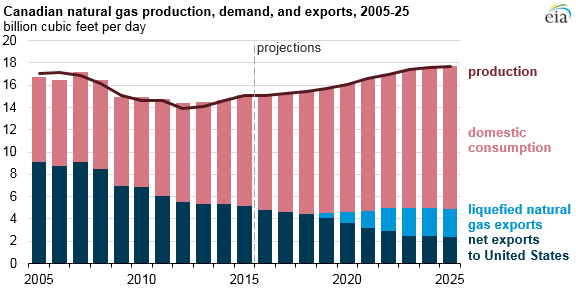
In its recent publication, Canada's Energy Future (CEF), Canada's National Energy Board (NEB) projects that both Canada's natural gas production and its domestic natural gas consumption will increase through the next decade. Exports of natural gas by pipeline to the United States are expected to continue to decline. The planned construction of liquefied natural gas (LNG) export terminals on Canada's western coast, which would send LNG exports to Asian markets by 2019, plays a key role in maintaining Canada's overall natural gas exports.
Highlights from Canada's outlook include:
Net natural gas exports to the United States. The NEB expects that Canadian natural gas net exports to the United States will fall to 2.5 billion cubic feet per day (Bcf/d) by 2025, shrinking to a negligible volume by 2040. Net exports to the United States have already decreased from a high of 10.6 Bcf/d in 2007 to 7.4 Bcf/d in 2014. With the continued development of U.S. shale resources, such as the Marcellus, the United States now relies less on Canadian imports to meet demand. By 2040, CEF projects that U.S. natural gas exports to eastern Canada will largely offset Canadian natural gas exports to the United States.
Liquefied natural gas exports to other destinations. With the decline of natural gas exports to the United States, LNG exports are expected to be the primary driver of Canadian natural gas production growth, with production growing from 15 Bcf/d in 2015 to nearly 18 Bcf/d in 2025. The NEB analyzes two additional cases in CEF to explore the impact of LNG exports on production. In a low-LNG case, where no liquefaction facilities are constructed, production remains at the 2015 level of 15 Bcf/d through 2040. In a high-LNG case, where LNG exports reach 4.0 Bcf/d by 2023 and 6.0 Bcf/d by 2030, production increases to 22 Bcf/d by 2040. Based on these results, CEF anticipates that future Canadian natural gas production growth will rely on the construction of LNG export capacity.
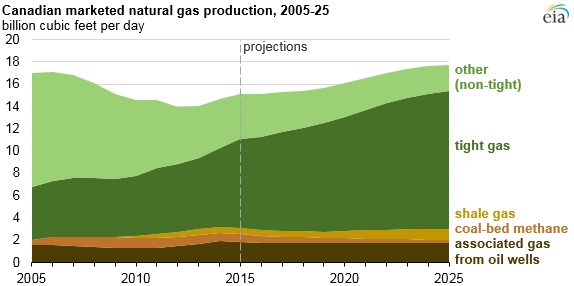
Natural gas production. Recent technological advances in horizontal drilling and hydraulic fracturing have led to increased development of tight gas and shale gas resources in the Western Canadian Sedimentary Basin. CEF expects this development to continue as Canada's domestic natural gas production grows to nearly 18 Bcf/d by 2025. Tight natural gas accounts for 70% of projected production in 2025, and most of this natural gas is from the Montney formation in British Columbia and Alberta, where production is projected to triple from 3.0 Bcf/d to 9.6 Bcf/d between 2014 and 2040. Production growth also occurs in the Alberta Deep Basin (tight) and the Horn River Basin (shale). These increases offset the decline in production from other resources.
Domestic natural gas consumption. Canadian natural gas consumption is also projected to rise, reaching 16.4 Bcf/d by 2025 and 18.6 Bcf/d by 2040. The industrial sector, which includes refining and oil exploration, is the primary driver of this growth, as well as the largest consumer of natural gas. Oil sands operations alone currently account for 20% of Canadian natural gas consumption. By 2040, CEF expects oil sands production to more than double to 4.8 million barrels per day, consuming 3.4 Bcf/d of natural gas. Another source of natural gas demand growth is electricity generation, whose consumption rises to more than 3.2 Bcf/d by the end of the projection period.
Principal contributor: Katie Dyl