Menu
Crude oil, gasoline, heating oil, diesel, propane, and other liquids including biofuels and natural gas liquids.
Exploration and reserves, storage, imports and exports, production, prices, sales.
Sales, revenue and prices, power plants, fuel use, stocks, generation, trade, demand & emissions.
Energy use in homes, commercial buildings, manufacturing, and transportation.
Reserves, production, prices, employment and productivity, distribution, stocks, imports and exports.
Includes hydropower, solar, wind, geothermal, biomass and ethanol.
Uranium fuel, nuclear reactors, generation, spent fuel.
Comprehensive data summaries, comparisons, analysis, and projections integrated across all energy sources.
Monthly and yearly energy forecasts, analysis of energy topics, financial analysis, congressional reports.
Financial market analysis and financial data for major energy companies.
Greenhouse gas data, voluntary reporting, electric power plant emissions.
Maps, tools, and resources related to energy disruptions and infrastructure.
State energy information, including overviews, rankings, data, and analyses.
Maps by energy source and topic, includes forecast maps.
International energy information, including overviews, rankings, data, and analyses.
Regional energy information including dashboards, maps, data, and analyses.
Tools to customize searches, view specific data sets, study detailed documentation, and access time-series data.
EIA's free and open data available as API, Excel add-in, bulk files, and widgets
Come test out some of the products still in development and let us know what you think!
EIA's open source code, available on GitHub.
Forms EIA uses to collect energy data including descriptions, links to survey instructions, and additional information.
Sign up for email subscriptions to receive messages about specific EIA products
Subscribe to feeds for updates on EIA products including Today in Energy and What's New.
Short, timely articles with graphics on energy, facts, issues, and trends.
Lesson plans, science fair experiments, field trips, teacher guide, and career corner.
EIA is continuing normal publication schedules and data collection until further notice.
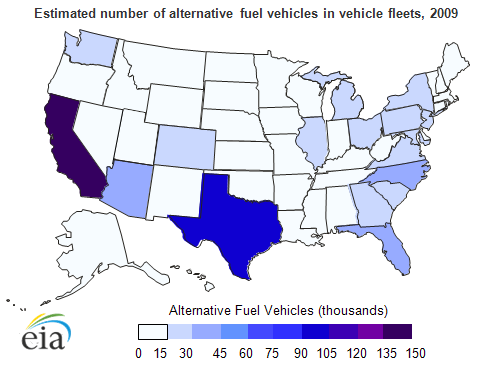
EIA estimates that the total inventory of alternative fuel vehicles (AFVs) in fleets in 2009 was about 826,318, up about 7% from 2008. Despite this growth, the availability of potential AFVs does not equate to actual use of AFVs because of uneven access to transportation fuels, specifically for ethanol.
The limited availability and economic viability of E85 fuel means that the vast majority of AFVs owned by individuals burn traditional fuels (gasoline and diesel). Gasoline and diesel electric hybrids are not AFVs as defined in the Energy Policy Act of 1992; their predominant fuel source is not an alternative fuel.
Vehicles consuming alternative transportation fuels are primarily part of fleets owned by Federal, State and local governments; fuel providers; transit agencies; or other private entities, where access to an alternative fuel has been established in response to various legislative regulations, incentives, and environmental interests.
Five states accounted for 40% of the fleet AFVs in use in 2009:
Tags: alternative fuels, biofuels, consumption/demand, ethanol, HGL (hydrocarbon gas liquid), liquid fuels, oil/petroleum, policy, propane, renewables, transportation, vehicles