
Oil and natural gas production job declines tend to lag oil price declines
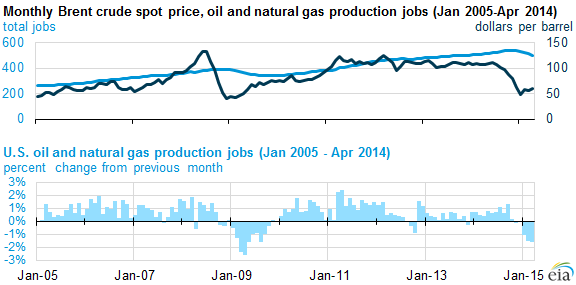
Employment in oil and natural gas extraction and support activities in the United States reached nearly 538,000 in October 2014, but then it declined by about 35,000 jobs, or 6.5%, over the following six months, through April 2015, according to data from the U.S. Bureau of Labor Statistics (BLS).
Declines in oil and natural gas extraction and support employment tend to lag declines in crude oil prices. As prices of North Sea Brent crude oil fell from their June 2014 level of $112 per barrel, firms reduced the number of new wells drilled and the associated workforce. The count of drilling rigs in the United States, as measured by Baker Hughes, totaled 857 for the week ending June 19, 54% below the same point a year ago and the lowest level in nearly six years.
Declines in production jobs lag oil price declines. In July 2008, Brent crude oil reached a record-high monthly spot price of $133 per barrel, before falling to $43 per barrel by February 2009. Oil and gas production jobs reached a high of 391,000 in September 2008, two months after the oil prices had started declining. Employment in drilling, extraction, and support activities then continued to decline for 13 months, when the number of production jobs dropped by more than 51,000. Most (82%) of the decline in these jobs occurred after oil prices reached the lowest monthly level and were on the rise.
BLS data showing declines in national oil and natural gas production jobs between October 2014 and May 2015 represent a contraction of about 6.5% of the industry workforce. Although unemployment rates for states that are heavily dependent on resources production remain well below the national average, the effects of reductions in oil and natural gas jobs are different in key states.
In oil-rich North Dakota, the unemployment rate slightly increased from 2.8% in October 2014 to 3.1% in May 2015, and Nebraska has replaced North Dakota as the state with the lowest unemployment rate. Oklahoma's unemployment rate also increased slightly from 4.1% to 4.3% in that period. But in Texas, where many reported reductions in oil and natural gas jobs occurred, the unemployment rate actually decreased from 4.7% in October 2014 to 4.1% in May 2015, because of offsetting growth in other areas of its more diverse economy.
Principal contributors: Robert McManmon, Grant Nülle