
Proposed Clean Power Plan rule cuts power sector CO2 emissions to lowest level since 1980s
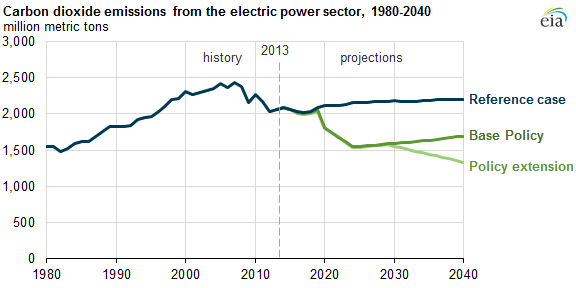
In June 2014, the U.S. Environmental Protection Agency (EPA) proposed a rule to regulate carbon dioxide (CO2) emissions from existing power plants under section 111(d) of the Clean Air Act. EIA's newly released analysis of the proposed rule shows power sector CO2 emissions falling to about 1,500 million metric tons per year by 2025, a level not seen since the early 1980s, in the Base Policy case.
The goal of the proposed Clean Power Plan rule is to reduce carbon dioxide emissions from existing electricity generation units that burn fossil fuels. EPA's proposed rule specifies interim state-level compliance targets for 2020 through 2029 and final compliance targets for 2030 that are maintained thereafter. The targets are expressed in terms of emissions from affected units divided by affected generation.
However, because the affected generation (i.e., the compliance formula denominator) used for compliance calculations includes generation from specified non-emitting sources, as well as reductions in load resulting from energy efficiency programs, the targets are not simple emissions rates. The emission rates used for compliance take into account emissions and generation from existing fossil-fired plants, as well as existing nonhydro renewable generation, all new renewable generation, 6% of existing nuclear generation plus nuclear generation from plants under construction, and contributions from energy efficiency programs that reduce electricity sales.
States subject to the proposed rule have freedom to exercise discretion in developing compliance plans. Available strategies include, but are not limited to, the following:
- Increasing use of existing natural gas-fired capacity and lower use of existing coal-fired generators
- Increasing use of lower-carbon technologies
- Implementing efficiency improvements at existing generators to lower energy input per unit of net electricity generation (heat rate improvement)
- Introducing new or expanded demand-side energy efficiency programs that reduce electricity sales
EIA's model does not represent the electricity system at the level of individual states. Therefore, EIA's analysis aggregates the targets in EPA's proposed rule to the 22 regions represented in its model. Within the regions it represents, EIA's analysis of the proposed rule does not assume or require specific levels for the individual compliance strategies. Rather, the model is allowed to choose the compliance strategy based on cost considerations. While EPA's proposal provides the flexibility to use rate-based or mass-based targets, EIA's analysis cases focus on rate-based standards. EIA's analysis is based on the original proposal from the EPA, so any subsequent revisions are not incorporated. Finally, EIA's analysis focuses on the implications for the energy system and the economy of reducing CO2 emissions under the proposed Clean Power Plan, but it does not consider any potential health or environmental benefits from reducing CO2 emissions. It is not a cost-benefit analysis.
EIA's analysis uses the Annual Energy Outlook 2015 (AEO2015) as a baseline. The proposed EPA rule is compared not only against the AEO2015 Reference case, but also against cases with higher macroeconomic growth or higher oil and natural gas resource availability assumptions. In the AEO2015 Reference case, which does not include the proposed Clean Power Plan rule, EIA projects power sector CO2 emissions to hover near their 2013 level, and remain below 2005 levels through 2040. In the Base Policy case that includes the proposed rule, power sector CO2 emissions are 25% below 2005 levels in 2020 and 34% below 2005 levels in 2030.
Because the emission rate standards stay constant after 2030, coal-fired generation can grow beyond 2030 as long as energy efficiency or renewable generation also grows, and the same average emissions rate is maintained. By 2040, the corresponding reduction is 30%, as continued growth in electricity demand leads to additional generation from fossil fuel-fired sources.
The request for this report also specified the analysis of a Policy Extension case. In this case, the compliance targets are assumed to continue to decrease after 2030, and CO2 emissions are 45% lower in 2040 compared with 2005 levels.
EIA's Analysis of the Impacts of the Clean Power Plan contains additional information and a complete range of sensitivity cases. Subsequent Today in Energy articles will highlight findings from the analysis, such as the implications of the proposed rule for the electricity generation mix, capacity retirements and additions, electricity prices, energy efficiency, and domestic production of coal and natural gas.
Principal contributor: EIA Staff