U.S. Energy Information Administration logo
Skip to sub-navigation
April 2, 2015

Financial hedging helps some producers mitigate effect of falling oil prices
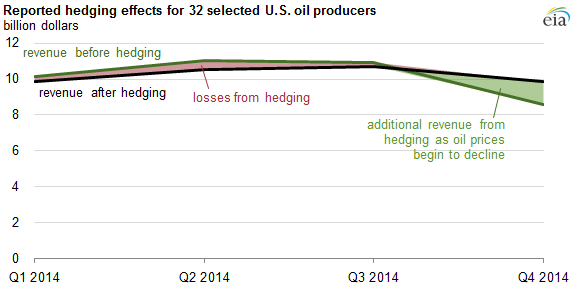
graph of reported hedging effects for 32 selected U.S. oil producers, as explained in the article text
Source: U.S. Energy Information Administration, based on Evaluate Energy
Note: Hedging is a financial risk-reduction strategy that market participants can use to lock in future prices.

The decline in crude oil prices since last summer has had a direct impact on oil producers' sales revenue, but hedging strategies have lessened the effects of lower prices on some producers' total revenue. Oil producers who adopt hedging strategies can reduce their price risk and generate smoother financial outcomes in unstable markets. A common hedging practice is to sell futures and swaps to lock in desired prices for future production, a practice that can shield producers' revenue from decreasing prices.

Analysis of hedging can be difficult because not all producers consistently report their hedging activity. In general, producers are not required to report hedge effectiveness in regulated financial statements. However, 32 U.S. oil producers have consistently reported their hedge results in their financial statements. The portfolio of these producers shows a 22% decline in oil sales revenue, down $2.4 billion from $10.9 billion in third-quarter 2014 to $8.6 billion in fourth-quarter 2014. But because of $1.3 billion from hedging activities, the combined sales and hedge revenue in fourth-quarter 2014 had a milder decrease of $1.1 billion.

Principal contributors: Richard Yan, Jozef Lieskovsky, Jeff Barron

Statistics
Analysis
Tools
Education
News

Petroleum & Other Liquids

Crude oil, gasoline, heating oil, diesel, propane, and other liquids including biofuels and natural gas liquids.

Natural Gas

Exploration and reserves, storage, imports and exports, production, prices, sales.

Electricity

Sales, revenue and prices, power plants, fuel use, stocks, generation, trade, demand & emissions.

Coal

Reserves, production, prices, employment and productivity, distribution, stocks, imports and exports.

Nuclear & Uranium

Uranium fuel, nuclear reactors, generation, spent fuel.

Renewable & Alternative Fuels

Includes hydropower, solar, wind, geothermal, biomass and ethanol.

EIA Survey Forms

Forms EIA uses to collect energy data including descriptions, links to survey instructions, and additional information.

Total Energy

Comprehensive data summaries, comparisons, analysis, and projections integrated across all energy sources.

U.S. States

State energy information, including overviews, rankings, data, and analyses.

International

International energy information, including overviews, rankings, data, and analyses.

Environment

Greenhouse gas data, voluntary reporting, electric power plant emissions.

Data Tools, Apps, & Maps

Tools to customize searches, view specific data sets, study detailed documentation, and access time-series data.

Open Data

EIA's free and open data available as API, Excel add-in, bulk files, and widgets

EIA Beta

Come test out some of the products still in development and let us know what you think!

Open Source Code

EIA's open source code, available on GitHub.

RSS Feeds

Subscribe to feeds for updates on EIA products including Today in Energy and What's New.