
Growth in residential electricity prices highest in 6 years, but expected to slow in 2015
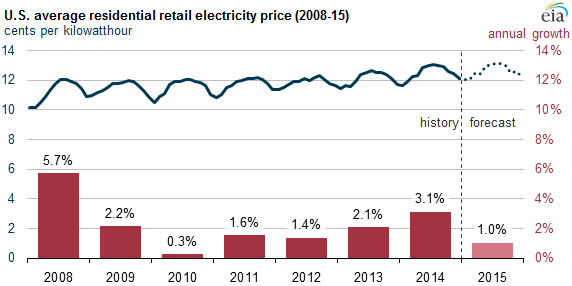
Residential electricity customers in most areas of the country experienced large increases in retail electricity prices during 2014, with the average U.S. residential price increasing 3.1% over the previous year. The increase represents the highest annual growth rate since 2008. EIA forecasts that prices will increase during 2015, but at a slower pace than in 2014.
Residential electricity rate increases during 2014 ranged from 1.3% in the Pacific Coast states to 9.9% in New England. Retail electricity prices have risen for various reasons. Many electric utilities purchase their power from regional wholesale electricity markets, which, at a national level, experienced higher prices last year. Other reasons commonly cited for higher retail electricity prices are the increased investment in transmission and distribution infrastructure, rising requirements to generate electricity from renewable energy sources, and utility investment in demand-side efficiency.
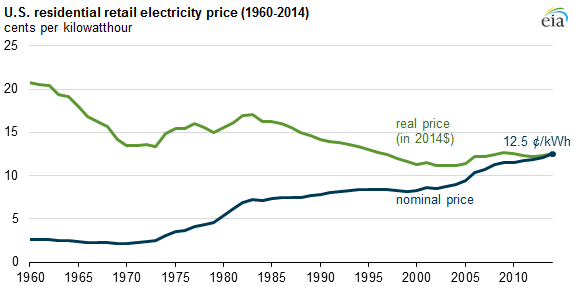
Despite recent increases, retail electricity prices have historically risen at a lower rate than the general rate of inflation, and the real price of electricity is lower than it was prior to 1995. Measured in constant 2014 dollars, the U.S. residential electricity price averaged 12.5 cents per kilowatthour in 2014, up slightly from its lowest point (in real terms) of 11.1 cents per kilowatthour in 2002.
The electricity industry likely will continue to invest in upgrades to transmission and distribution systems in the coming years as well as expand renewable generating capacity, the costs of which will be passed through to retail customers. Costs associated with environmental compliance also will affect future retail electricity rates.
However, power generation fuel costs have fallen in recent months, especially the cost of natural gas. These lower costs are likely to offset some of the increases in utilities' nonfuel costs and thus slow the rate of retail electricity price increases. EIA's March edition of the Short-Term Energy Outlook projects residential electricity prices will rise by 1.0% during 2015, which would be the lowest increase since 2010.
Principal contributor: Tyler Hodge
Tags: electricity, prices, residential