U.S. Energy Information Administration logo
Skip to sub-navigation
February 12, 2015

Saudi Arabia budget insulated from effects of lower oil prices
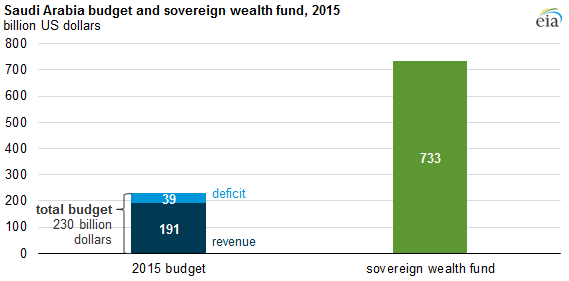
Graph of Saudi Arabia budget and sovereign wealth fund, as explained in the article text
Source: U.S. Energy Information Administration, based on Bloomberg, International Monetary Fund

Saudi Arabia is the largest exporter of crude oil and other petroleum liquids in the world, and their oil exports accounted for 89% of the country's total revenue in 2014. The recent decline in global oil prices is decreasing the value of these exports, leading to a potential budget shortfall. In its 2015 budget, Saudi Arabia plans to spend about $230 billion but expects to take in $190.7 billion in revenue, resulting in an overall deficit of $38.6 billion. While the oil price assumption was not specified in Saudi Arabia's budget, the budget was crafted in December 2014, when crude oil prices were between $55 and $70 dollars per barrel.

In addition to having the second-largest proved oil reserves—268 billion barrels, or 16%, of the world total in 2014, behind only Venezuela's 298 billion barrels—Saudi Arabia has a massive sovereign wealth fund (SWF) that will enable it to weather lower oil prices. To maintain spending at the same level as in the past, Saudi Arabia would need to tap its SWF, which currently has $733 billion, or about 19 times its expected 2015 budget shortfall of $39 billion. Consequently, the short-term effect of lower oil prices on Saudi Arabia should be minimal. In contrast, OPEC's decision to keep crude oil production near present levels, keeping supply high and prices low, has affected the budgets of members that lack Saudi Arabia's financial reserves.

If oil prices remain low for an extended period and spending levels remain similar to recent history, Saudi Arabia will continue to run a budget deficit. Even with the SWF, Saudi Arabia's ability to grow, strengthen, and even diversify its economy depends on a steady stream of revenue from the sale of this oil over the long term.

Principal contributor: Joseph Ayoub

Statistics
Analysis
Tools
Education
News

Petroleum & Other Liquids

Crude oil, gasoline, heating oil, diesel, propane, and other liquids including biofuels and natural gas liquids.

Natural Gas

Exploration and reserves, storage, imports and exports, production, prices, sales.

Electricity

Sales, revenue and prices, power plants, fuel use, stocks, generation, trade, demand & emissions.

Coal

Reserves, production, prices, employment and productivity, distribution, stocks, imports and exports.

Nuclear & Uranium

Uranium fuel, nuclear reactors, generation, spent fuel.

Renewable & Alternative Fuels

Includes hydropower, solar, wind, geothermal, biomass and ethanol.

EIA Survey Forms

Forms EIA uses to collect energy data including descriptions, links to survey instructions, and additional information.

Total Energy

Comprehensive data summaries, comparisons, analysis, and projections integrated across all energy sources.

U.S. States

State energy information, including overviews, rankings, data, and analyses.

International

International energy information, including overviews, rankings, data, and analyses.

Environment

Greenhouse gas data, voluntary reporting, electric power plant emissions.

Data Tools, Apps, & Maps

Tools to customize searches, view specific data sets, study detailed documentation, and access time-series data.

Open Data

EIA's free and open data available as API, Excel add-in, bulk files, and widgets

EIA Beta

Come test out some of the products still in development and let us know what you think!

Open Source Code

EIA's open source code, available on GitHub.

RSS Feeds

Subscribe to feeds for updates on EIA products including Today in Energy and What's New.