U.S. Energy Information Administration logo
Skip to sub-navigation
June 16, 2011

Age of electric power generators varies widely
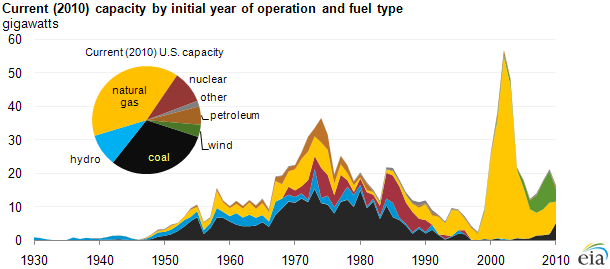
graph of Current (2010) capacity by initial year of operation and fuel type, as described in the article text

Source: U.S. Energy Information Administration, Form EIA-860 Annual Electric Generator Report , and Form EIA-860M (see Table ES3 in the March 2011 Electric Power Monthly)
Note: Data for 2010 are preliminary. Generators with online dates earlier than 1930 are predominantly hydroelectric. Data include non-retired plants existing as of year-end 2010. This chart shows the most recent (summer) capacity data for each generator. However, this number may change over time, if a generator undergoes an uprate or derate.
Download CSV Data

The current fleet of electric power generators has a wide range of ages. The oldest power plants tend to be hydropower generators. Most coal-fired plants were built before 1980. There was a wave of nuclear plant construction from the late 1960s to about 1990. The most recent waves of generating capacity additions include natural gas-fired units in the 2000s and renewable units, primarily wind, coming online in the late 2000s.

An upcoming series of Today in Energy articles will examine trends in generating capacity additions by fuel type, for coal, hydro, nuclear, natural gas, petroleum, and wind. The 'other' category includes solar, biomass, and geothermal generators, as well as landfill gas, municipal solid waste, and a variety of small-magnitude fuels such as byproducts from industrial processes (e.g., black liquor, blast furnace gas).

About 530 GW, or 51% of all generating capacity, were at least 30 years old at the end of 2010 (see chart below). Most gas-fired capacity is less than 10 years old, while 73% of all coal-fired capacity was 30 years or older at the end of 2010.
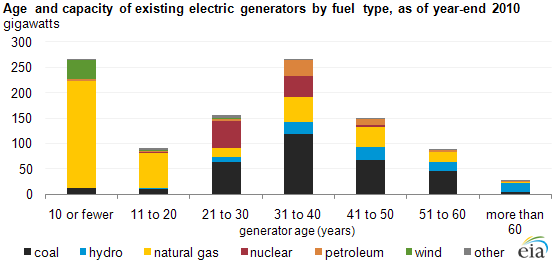
graph of Age and capacity of existing electric generators by fuel type, as of year-end 2010, as described in the article text

Source: U.S. Energy Information Administration, Form EIA-860 Annual Electric Generator Report , and Form EIA-860M (see Table ES3 in the March 2011 Electric Power Monthly)
Download CSV Data
Statistics
Analysis
Tools
Education
News

Petroleum & Other Liquids

Crude oil, gasoline, heating oil, diesel, propane, and other liquids including biofuels and natural gas liquids.

Natural Gas

Exploration and reserves, storage, imports and exports, production, prices, sales.

Electricity

Sales, revenue and prices, power plants, fuel use, stocks, generation, trade, demand & emissions.

Coal

Reserves, production, prices, employment and productivity, distribution, stocks, imports and exports.

Nuclear & Uranium

Uranium fuel, nuclear reactors, generation, spent fuel.

Renewable & Alternative Fuels

Includes hydropower, solar, wind, geothermal, biomass and ethanol.

EIA Survey Forms

Forms EIA uses to collect energy data including descriptions, links to survey instructions, and additional information.

Total Energy

Comprehensive data summaries, comparisons, analysis, and projections integrated across all energy sources.

U.S. States

State energy information, including overviews, rankings, data, and analyses.

International

International energy information, including overviews, rankings, data, and analyses.

Environment

Greenhouse gas data, voluntary reporting, electric power plant emissions.

Data Tools, Apps, & Maps

Tools to customize searches, view specific data sets, study detailed documentation, and access time-series data.

Open Data

EIA's free and open data available as API, Excel add-in, bulk files, and widgets

EIA Beta

Come test out some of the products still in development and let us know what you think!

Open Source Code

EIA's open source code, available on GitHub.

RSS Feeds

Subscribe to feeds for updates on EIA products including Today in Energy and What's New.