
Everywhere but Northeast, fewer homes choose natural gas as heating fuel
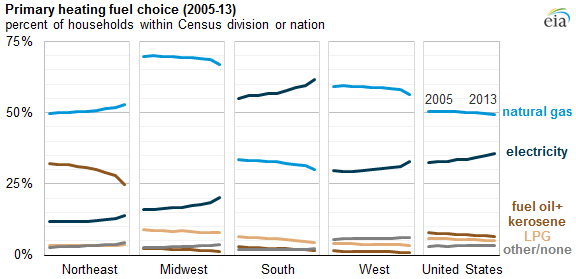
Note: Geographic areas based on Census regions. LPG is liquefied petroleum gas.
On a national basis, natural gas has long been the dominant choice for primary heating fuel in the residential sector. Lately, electricity has been gaining market share while natural gas, distillate fuel oil, kerosene, and liquefied petroleum gas (propane) have declined.
Part of the national change in heating fuel choice can be attributed to population migrations farther west and south. But even within Census regions, electricity has been gaining market share at the expense of natural gas. The Northeast is the exception, as both natural gas and electricity have been increasing while distillate fuel oil and kerosene have declined.
In the Midwest, most homes are heated by natural gas. The Midwest also has the highest percentage of homes heated by propane, although both natural gas and propane have lost market share to electricity since 2005. The South is the only Census region where electricity is the main space heating fuel in the majority of homes. Heating fuel preferences in the West largely mirror the national average, although households in the West are more likely to use wood as their primary heating fuel or to report not using heating equipment at all.
Improvements in electric heat pump technology have improved efficiency and extended the range of temperatures that heat pumps can operate in before resorting to back-up heating, which is most often an electric resistance element similar to that used in a toaster or an electric dryer. Electric resistance heating is effective but relatively expensive to operate.
Heating fuel choice reflects decisions made by home builders and owners. EIA data show that homes built since 1970 use electricity and natural gas as their main heating fuel in roughly equal proportions. Often the choice of heating fuel in new construction has long-term implications, as fuel switching can be expensive. In addition to buying new equipment and removing old equipment, ductwork, pipes, flues, pumps, and fans may need to be installed or removed.
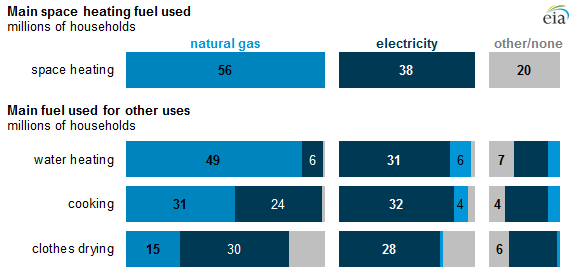
Space heating is the largest portion of household energy use in most areas of the country, and the choice of main heating fuel also influences the fuels chosen for other end uses such as water heating, cooking, and clothes drying. EIA's Residential Energy Consumption Survey (RECS) collects data on fuels used for these purposes, which account for about 65% of 2014 residential delivered energy consumption. The most recent survey data show that homes using natural gas as their main space heating fuel are more likely to also use natural gas for other purposes. Nationally, only 20% of clothes dryers use natural gas, but in homes with natural gas as their main space heating fuel, that percentage increases to 34%. Of the homes using electricity as their primary heating fuel, about 96% used electric clothes dryers.
Principal contributor: Owen Comstock