
Average Brent crude oil prices trade within $5 per barrel range for 13 months in a row
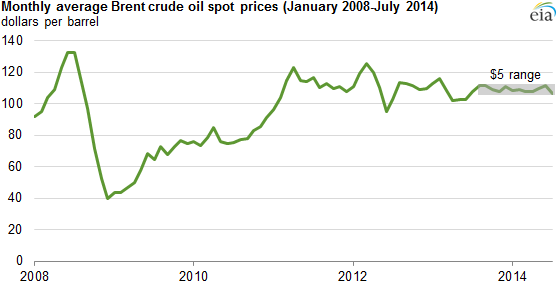
Brent crude oil spot prices averaged $107 per barrel (bbl) in July, marking the 13th consecutive month in which average Brent crude oil prices were between $107/bbl and $112/bbl (see graph above). Although supply growth from non-OPEC countries has outpaced world consumption in the past year, its potential price-reducing effect has been offset by unplanned supply outages among producers in the Organization of the Petroleum Exporting Countries (OPEC). The result has tightened world oil markets and placed upward pressure on prices.
This price stability has been remarkable compared with the volatility seen as recently as two years ago, when Brent spot prices ranged from as high as $125/bbl in March 2012, to as low as $95/bbl in June 2012. Implied volatility (a measure of expected price variation) for the near-month Brent futures contract has averaged 18% over the past 12 months, compared with 28% during the previous 24 months.
Most non-OPEC supply growth over the past two years has come from the United States and Canada, whose supply rose from a combined 14.7 million bbl/d in July 2012 to 18.2 million bbl/d in July 2014. This increase is largely the result of growing crude oil production from U.S. tight oil formations, and has led to reduced petroleum imports. This cutback freed previously imported barrels for non-U.S. consumption. Largely as a result, Brent crude oil prices fell from an average of $112/bbl in 2012 to $109/bbl in 2013.
Since June 2013, OPEC supply has fallen by 0.6 million bbl/d, decreasing in 7 of the past 13 months, primarily due to unplanned supply disruptions caused by political unrest in Libya and Iraq.
Despite recent disruptions to OPEC supply and tighter world oil balances, EIA expects continued strong growth in non-OPEC supply to place downward pressure on Brent crude oil prices, causing them to gradually decrease through 2015, according to EIA's August 2014 Short-Term Energy Outlook. EIA forecasts that total world petroleum and other liquids supply will grow by 1.5 million bbl/d and 1.3 million bbl/d in 2014 and 2015, respectively, while Brent crude oil prices are forecasted to fall from an average of $108/bbl in 2014 to an average of $105/bbl in 2015.
Principal contributor: Sean Hill