
Natural gas serves a small, but growing, portion of China’s total energy demand
Note: Click to enlarge.
China relies heavily on domestic coal (and to a lesser extent oil) to meet rising energy consumption. To reduce air pollution and carbon dioxide emissions, the Chinese government is attempting to replace some of the country's coal and oil use with natural gas. Natural gas accounted for only 4.9% of China's total energy consumption in 2012, but large investments in domestic natural gas production and infrastructure, along with growing imports, are likely to underpin a significantly larger role in the future. The Chinese government anticipates increasing its natural gas share of total energy consumption to around 8% by the end of 2015 and 10% by 2020.
China more than tripled natural gas production since 2003, producing 3.8 trillion cubic feet (Tcf) in 2012, and the government is targeting production to reach about 5.5 Tcf of natural gas per year by the end of 2015. Most of the anticipated production growth is from large onshore fields in the western and north central regions of China as well as from the offshore deepwater regions in the South China Sea. China's natural gas consumption has outstripped domestic supply since 2007, triggering rising imports of both liquefied natural gas (LNG) and pipeline gas. China's natural gas consumption rose at an average annual rate of 17% from 2003 through 2013, reaching nearly 5.7 Tcf in 2013.
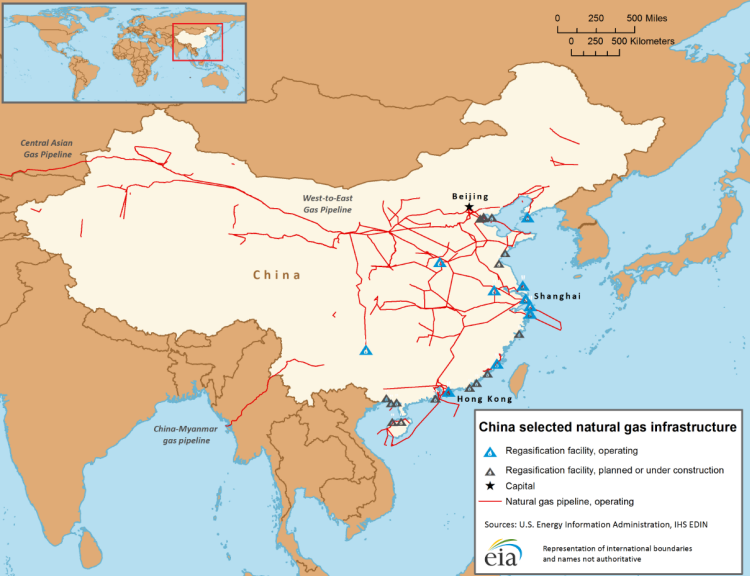
In 2013, China imported nearly 1.8 Tcf of LNG and pipeline gas to fill the growing gap between supply and demand. Imported natural gas met 32% of China's demand in 2013, up from 2% in 2006. China is swiftly developing its LNG import capacity in the urban coastal areas and currently has 10 major regasification terminals with 1.7 Tcf/y of capacity. In 2012, China rose to become the third-largest LNG importer in the world, after Japan and South Korea, and in 2013, the country imported 870 billion cubic feet (Bcf) of LNG. Estimates for the first half of 2014 show LNG imports growing at faster levels than in previous years.
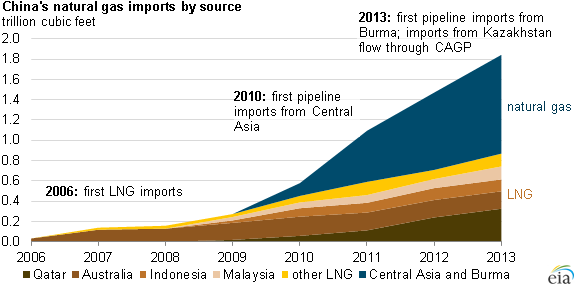
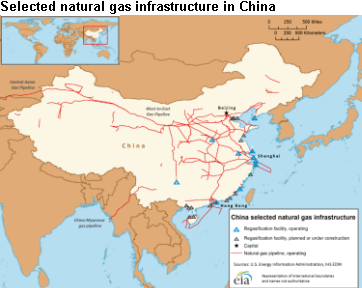
China also continues to invest in natural gas pipeline infrastructure that will link production areas in the western and northern regions to demand centers along the coast. This new infrastructure will accommodate greater imports from neighboring countries. In 2010, the first pipeline imports flowed to China from Turkmenistan through the Central Asia Gas Pipeline (CAGP), and by 2013, natural gas supplies from Turkmenistan, Uzbekistan, and Kazakhstan reached 974 Bcf. In 2013, China added natural gas imports from Kazakhstan through the CAGP and Myanmar through a newly built pipeline. China and Russia recently finalized a natural gas agreement that allows China to purchase and transport gas from eastern Russia through a proposed pipeline. The deal, valued at approximately $400 billion, will supply China with up to 1.3 Tcf of natural gas per year starting in 2018.
China's potential wealth of shale gas, coalbed methane, and coal-to-gas resources has spurred the government to invest and partner with foreign companies that have technical expertise to unlock these reserves. According to EIA estimates, China holds the largest reserves of technically recoverable shale gas in the world, although investors face geological, technical and water resource challenges, regulatory hurdles, transportation constraints, and competition with other fuels.
For more information see EIA's Country Analysis Brief on China.
Principal contributor: Candace Dunn