U.S. Energy Information Administration logo
Skip to sub-navigation
February 27, 2014

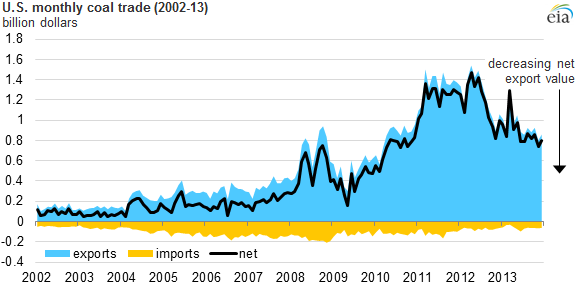
Dollar value of U.S. net coal exports has increased more than three-fold since 2005
graph of monthly coal trade, as explained in the article text
Source: U.S. Census Bureau: Foreign Trade Division

Although coal trade only accounts for about 5% of trade flows in energy fuels, the volume of U.S. coal exports has steadily increased, from 50 million short tons (MMst) in 2005 to a record 126 MMst in 2012. Export volumes set a monthly record in March 2013, before declining in the second half of the year. Coal exports are an increasingly important source of revenue for U.S. coal producers, railroads, and barge companies. Coal's transportation through the supply chain affects its delivered price.

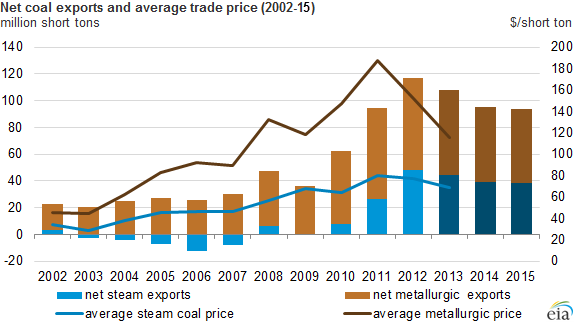
The recent growth in coal net exports has been driven by volume increases in steam coal exports and price increases in metallurgical coal, which generally sells at a significantly higher price per short ton than steam coal.
graph of net coal exports and average trade price, as explained in the article text
Source: EIA Quarterly Coal Report
Note: Data for 2013-15 are from the February issue of the Short-Term Energy Outlook.

According to EIA's Quarterly Coal Report, most U.S. coal exports go to Europe (50%), followed by Asia (26%), North America (11%), and South America (10%). Export growth has been strongest in Asia and South America. The U.S. continues to import small quantities of coal, primarily from Colombia (73%), Canada (14%), and Indonesia (8%). U.S. coal imports in third-quarter 2013 decreased to 2.4 MMst from 2.8 MMst in second-quarter 2013.

Despite the 2013 pullback in both volume and value, coal exports will continue to be important for companies involved in coal production and transportation. Key drivers of future U.S. coal exports include global coal demand and production challenges that may arise in domestic production in China and India, the world's major coal consumers, and in production by leading global coal exporters, including Australia, Indonesia, and South Africa. The Annual Energy Outlook 2014 Reference case projects modest growth in U.S. coal exports, which reach 160 MMst by 2040.

Principal contributors: Robert McManmon, Michael Ford

Statistics
Analysis
Tools
Education
News

Petroleum & Other Liquids

Crude oil, gasoline, heating oil, diesel, propane, and other liquids including biofuels and natural gas liquids.

Natural Gas

Exploration and reserves, storage, imports and exports, production, prices, sales.

Electricity

Sales, revenue and prices, power plants, fuel use, stocks, generation, trade, demand & emissions.

Coal

Reserves, production, prices, employment and productivity, distribution, stocks, imports and exports.

Nuclear & Uranium

Uranium fuel, nuclear reactors, generation, spent fuel.

Renewable & Alternative Fuels

Includes hydropower, solar, wind, geothermal, biomass and ethanol.

EIA Survey Forms

Forms EIA uses to collect energy data including descriptions, links to survey instructions, and additional information.

Total Energy

Comprehensive data summaries, comparisons, analysis, and projections integrated across all energy sources.

U.S. States

State energy information, including overviews, rankings, data, and analyses.

International

International energy information, including overviews, rankings, data, and analyses.

Environment

Greenhouse gas data, voluntary reporting, electric power plant emissions.

Data Tools, Apps, & Maps

Tools to customize searches, view specific data sets, study detailed documentation, and access time-series data.

Open Data

EIA's free and open data available as API, Excel add-in, bulk files, and widgets

EIA Beta

Come test out some of the products still in development and let us know what you think!

Open Source Code

EIA's open source code, available on GitHub.

RSS Feeds

Subscribe to feeds for updates on EIA products including Today in Energy and What's New.