
Glass manufacturing is an energy-intensive industry mainly fueled by natural gas
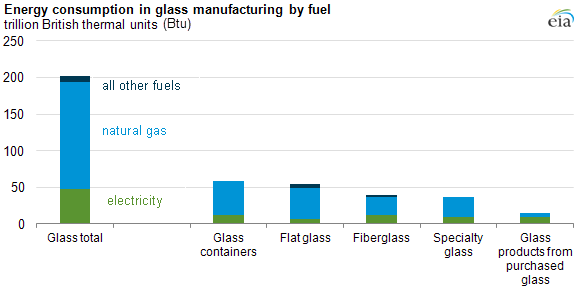
The industrial sector, which includes manufacturing, mining, agriculture, and construction, accounted for nearly a third of total U.S. energy use in 2012, and energy-intensive manufacturing, including the glass industry, accounted for a little more than half of total industrial energy use. Glass manufacturing is among the most energy-intensive industries.
The glass industry energy consumption per unit of output ratio (13,140 Btu per 2005 dollar shipments) is similar to that of other energy-intensive industries. However, because glass has a low volume of shipments compared to other energy-intensive industries, the share of total industrial energy use is lower for glass.
Glass manufacturing accounted for 1% of total industrial energy use in EIA's most recent survey of the manufacturing sector. Overall fuel use is dominated by natural gas (73%) and electricity (24%), with the remaining share (3%) from several other fuels. Natural gas use at glass manufacturing facilities in 2010 was 146 trillion Btu, about 143 billion cubic feet.
The bulk of energy consumed in the glass manufacturing industry comes from natural gas combustion used to heat furnaces to melt raw materials to form glass. These furnaces are mainly natural gas-fired, but there are a small number of electrically-powered furnaces. Many glass furnaces also use electric boosting (supplementary electric heating systems) to increase throughput and quality. After the melting and refining process is complete, the glass is formed and finished to create the final product. Specific manufacturing processes depend on the intended product, and can include annealing (slow cooling), tempering, coating, and polishing, which require additional energy.
Different types of glass include
- Container glass for packaging foods, beverages, and cosmetics
- Flat glass for residential and commercial construction, automotive applications, tabletops, and mirrors
- Fiberglass for insulation and roofing
- Specialty glass that is pressed and blown glass for tableware, cookware, lighting, laboratory equipment, and other uses
- Purchased glass serves as an input to produce glass containers, flat glass, glassware and high-value products such as some optical lenses and fiber optic cable
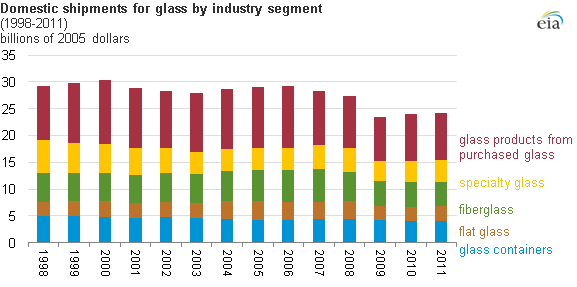
Glass shipments are sensitive to changes in the gross domestic product (GDP). During the 2007-09 economic downturn, shipments in the Commerce Department category called glass containers declined by about 4%, while shipments of all other segments of the glass industry declined by about 20%. The total value of glass industry shipments in 2011 was $19.3 billion (in 2005 dollars). Energy use in the glass industry is estimated to have increased by only 1% between 2010 and 2013.
There is substantial potential for energy efficiency improvements in glass manufacturing. Estimates range from 20% to 25%, mainly focused on the extremely energy-intensive melting and refining process. Energy used in other key glass-making processes, such as forming, is highly variable depending on the product, so those processes don't have the same potential for efficiency gains.