U.S. Energy Information Administration logo
Skip to sub-navigation
May 5, 2011

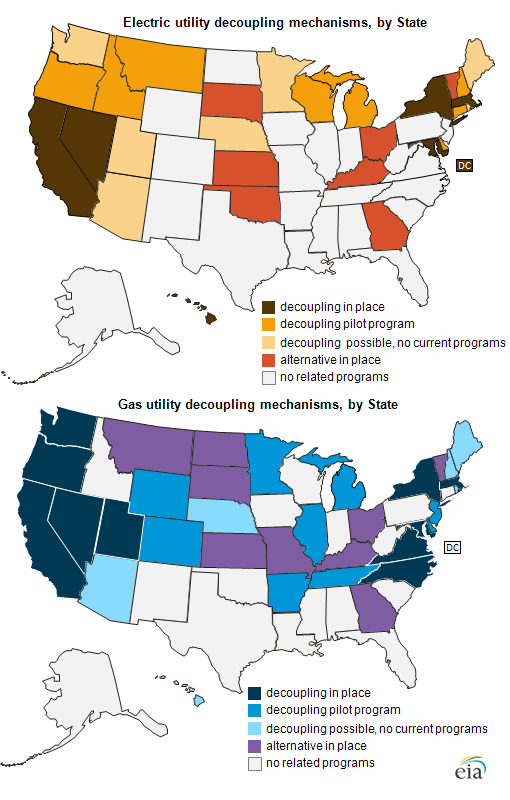
Decoupling treatment of electric and gas utilities can differ within a State

maps of Decoupling treatment of electric and gas utilities can differ within a State, as described in the article text

Sources: U.S. Energy Information Administration, derived from the American Council for an Energy-Efficient Economy (Oct 2010) and SNL Energy (Regulatory Research Associates, April 2011)
Note: Map colors above are determined by the operation of at least one natural gas or electric utility under the specified rate type. Other utilities in the same State may, but do not necessarily, operate under similar programs. Rate adjustments for variations in demand due to weather only are not included.

Today in Energy on May 4, 2011 discussed how utility regulators can use rate design to improve a utility's economic incentive to promote energy efficiency or conservation programs by decoupling a utility's revenue from its sales. However, there are differences in the application of decoupled rates between the electric and gas utilities, even within a single State.

Many States institute decoupled rates for both electric and gas utilities (e.g., California, New York, Massachusetts). Others vary their treatment; for example, Virginia and North Carolina have both decoupled gas rates but not electric rates. Decoupling on the gas side has a longer history and is more established.

Statistics
Analysis
Tools
Education
News

Petroleum & Other Liquids

Crude oil, gasoline, heating oil, diesel, propane, and other liquids including biofuels and natural gas liquids.

Natural Gas

Exploration and reserves, storage, imports and exports, production, prices, sales.

Electricity

Sales, revenue and prices, power plants, fuel use, stocks, generation, trade, demand & emissions.

Coal

Reserves, production, prices, employment and productivity, distribution, stocks, imports and exports.

Nuclear & Uranium

Uranium fuel, nuclear reactors, generation, spent fuel.

Renewable & Alternative Fuels

Includes hydropower, solar, wind, geothermal, biomass and ethanol.

EIA Survey Forms

Forms EIA uses to collect energy data including descriptions, links to survey instructions, and additional information.

Total Energy

Comprehensive data summaries, comparisons, analysis, and projections integrated across all energy sources.

U.S. States

State energy information, including overviews, rankings, data, and analyses.

International

International energy information, including overviews, rankings, data, and analyses.

Environment

Greenhouse gas data, voluntary reporting, electric power plant emissions.

Data Tools, Apps, & Maps

Tools to customize searches, view specific data sets, study detailed documentation, and access time-series data.

Open Data

EIA's free and open data available as API, Excel add-in, bulk files, and widgets

EIA Beta

Come test out some of the products still in development and let us know what you think!

Open Source Code

EIA's open source code, available on GitHub.

RSS Feeds

Subscribe to feeds for updates on EIA products including Today in Energy and What's New.