U.S. Energy Information Administration logo
Skip to sub-navigation
July 1, 2013

The cement industry is the most energy intensive of all manufacturing industries
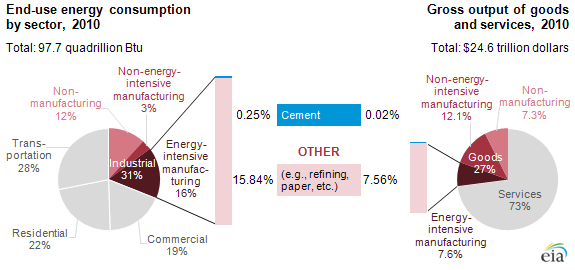
graph of energy consumption and intensity, as explained in the article text
Source: U.S. Energy Information Administration, Department of Commerce, Bureau of Economic Analysis.

The industrial sector, which encompasses manufacturing, mining, agriculture, and construction, accounted for almost a third of total U.S. energy use in 2012. Energy-intensive manufacturing accounted for a little more than half of total industrial energy use. Although the cement industry used only one-quarter of one percent of total U.S. energy, it is the most energy-intensive of all manufacturing industries, with a share of national energy use roughly 10 times its share of the nation's gross output of goods and services. On average, other energy intensive industries' share of energy use is roughly twice their share of gross output. Cement is also unique in its heavy reliance on coal and petroleum coke.

Over the long term, EIA projections show an increasing contribution from the cement industry to energy consumption as well as increasing share of total gross output of goods and services (see charts below). Cement output is strongly tied to various types of construction.
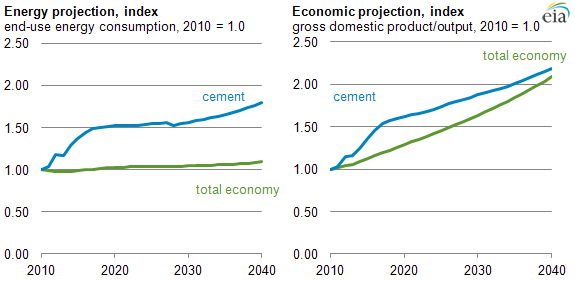
graph of energy and economic projections, as explained in the article text
Source: U.S. Energy Information Administration AEO2013.

The most recent EIA manufacturing sector survey data are available in the Manufacturing Energy Consumption Survey (MECS2010). For more discussion of the industrial sector and individual industries, see EIA's Industry Analysis Briefs and the Annual Energy Outlook 2013 (AEO2013).

Statistics
Analysis
Tools
Education
News

Petroleum & Other Liquids

Crude oil, gasoline, heating oil, diesel, propane, and other liquids including biofuels and natural gas liquids.

Natural Gas

Exploration and reserves, storage, imports and exports, production, prices, sales.

Electricity

Sales, revenue and prices, power plants, fuel use, stocks, generation, trade, demand & emissions.

Coal

Reserves, production, prices, employment and productivity, distribution, stocks, imports and exports.

Nuclear & Uranium

Uranium fuel, nuclear reactors, generation, spent fuel.

Renewable & Alternative Fuels

Includes hydropower, solar, wind, geothermal, biomass and ethanol.

EIA Survey Forms

Forms EIA uses to collect energy data including descriptions, links to survey instructions, and additional information.

Total Energy

Comprehensive data summaries, comparisons, analysis, and projections integrated across all energy sources.

U.S. States

State energy information, including overviews, rankings, data, and analyses.

International

International energy information, including overviews, rankings, data, and analyses.

Environment

Greenhouse gas data, voluntary reporting, electric power plant emissions.

Data Tools, Apps, & Maps

Tools to customize searches, view specific data sets, study detailed documentation, and access time-series data.

Open Data

EIA's free and open data available as API, Excel add-in, bulk files, and widgets

EIA Beta

Come test out some of the products still in development and let us know what you think!

Open Source Code

EIA's open source code, available on GitHub.

RSS Feeds

Subscribe to feeds for updates on EIA products including Today in Energy and What's New.