
Heating oil futures contract now uses ultra-low sulfur diesel fuel
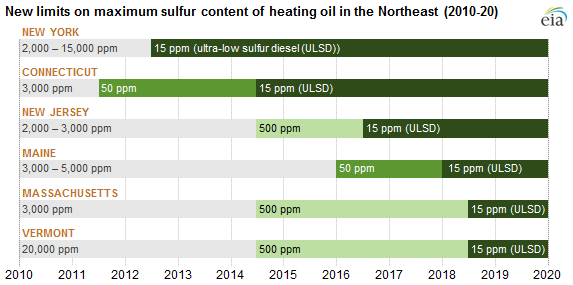
Note: Connecticut has passed legislation with the above requirements. However, the law requires New York, Massachusetts, and Rhode Island to have similar restrictions in place to trigger compliance, and as a result, no sulfur restrictions are yet enforced on heating oil. Specifications change on July 1 of the years shown, with the exception of Maine's requirements, which change on January 1.
Note: ppm denotes parts per million
Historically, standard futures contracts for heating oil allowed for delivery of product with sulfur content up to 2,000 parts per million (0.2%). Beginning with the May 1, 2013 contract, the New York Mercantile Exchange (Nymex) switched its specification for the heating oil futures contract to the ultra-low sulfur diesel specification (ULSD). The ULSD contract is a distillate that contains less than 15 parts per million (ppm) of sulfur, the same specification used for most diesel fuel. Many states in the Northeast require the switch over the next several years (see chart) to lower sulfur heating oil. Switching the contract to reference ULSD lets market participants more easily hedge their distillate investments.
The new contract specifications were announced in April 2012 and took effect with futures contracts for delivery starting in May 2013 that are traded on Nymex and the CME Globex platform. The new specifications reflect the changing regulatory climate for heating oil in northeastern states, which as a region have the highest consumption of heating oil in the United States. The new contract will have a physical effect as well, by changing the nature of the products stored by industry in New York Harbor (NYH) tankage. Because NYH is the delivery point of the Nymex futures contract and because most terminals are expected to store only one commingled product (ULSD), rather than segregating two distillate products (home heating oil and ULSD), physical delivery of higher sulfur home heating oil would become difficult in the near future.
New York was the first state to limit sulfur content in distillate used for heating purposes in July 2012, requiring that heating oil contain less than 15 ppm. Other northeastern states plan to follow suit, with Connecticut, Maine, Massachusetts, New Jersey, and Vermont all scheduled to require ULSD for heating purposes by 2018.
This change is likely to result in a slightly higher heating oil futures price when compared to historical prices. Since ULSD contains lower amounts of sulfur and requires more refining steps to make, it typically has a premium to distillate fuels with higher levels of sulfur. In February and March, the difference between the April heating oil contract and the May heating oil contract averaged nearly $0.08 per gallon.
Tags: Connecticut, diesel, futures, heating oil, liquid fuels, Maine, Massachusetts, New Jersey, New York, oil/petroleum, prices, states