
January 2013 crude oil export to China was a rare event
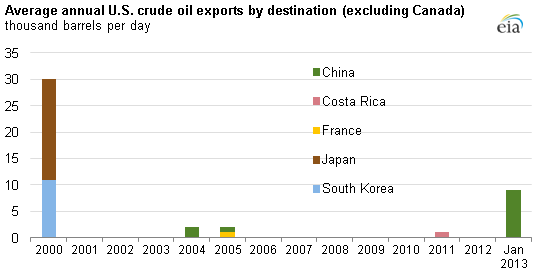
The United States exported 9,000 barrels per day (bbl/d) of foreign-origin crude oil to China in January 2013, according to data EIA released on March 28. Many media outlets picked up this information, noting that the United States had not exported crude oil to China since 2005. However, the United States does export small amounts of crude oil on a regular basis, mostly to Canada, which is not shown on the graph. From 2003 to 2012, the United States exported an average of 35,000 bbl/d of crude oil — 98% of those exports were delivered to Canada. By comparison, in January 2013, the United States imported nearly 8 million barrels per day, while producing about 7 million barrels per day.
To export crude oil, a company must obtain a license from the Bureau of Industry and Security (BIS), which is part of the U.S. Department of Commerce, and which relies on the Code of Federal Regulations Title 15 Part 754.2. According to the regulations, "BIS will approve applications to export crude oil for the following kinds of transactions if BIS determines that the export is consistent with the specific requirements pertinent to that export:"
- From Alaska's Cook Inlet
- To Canada for consumption or use therein
- In connection with refining or exchange of Strategic Petroleum Reserve oil
- Of up to an average of 25,000 bbl/d of California heavy crude oil
- That are consistent with findings made by the president under an applicable statute
- Of foreign-origin crude oil where, based on written documentation satisfactory to BIS, the exporter can demonstrate that the oil is not of U.S. origin and has not been commingled with oil of U.S. origin
As noted above, the vast majority of U.S. crude exports go to Canada. Most of the other exports of crude oil are those that fall into the last category—exports of foreign-origin crude, imported into the United States but not comingled with U.S.-origin crude oil. These exports typically occur because the owner of the imported crude oil cannot process or resell it in the United States. The license allows the imported crude to be exported.
EIA does not collect data on crude oil (or petroleum product) exports, but rather publishes data collected by the U.S. Census Bureau. The Census data show that since 2003, there have been only a handful of crude oil exports from the United States to a country other than Canada. These exports include small volumes to China, Costa Rica, France, South Korea and Mexico.
The 9,000 bbl/d of oil that the United States exported to China in January 2013 was a rare event. For confidentiality reasons, the U.S. Census Bureau is not allowed to publish specifics about particular shipments, but data available from the U.S. Census Bureau indicate this crude oil was not listed as a domestic export, implying that the crude oil was foreign-origin crude oil that was imported into the United States and then exported from the United States to China.