
Sales of specialty incandescent bulbs decline despite exemption from efficiency standards
Note: EISA is the Energy Independence and Security Act of 2007.
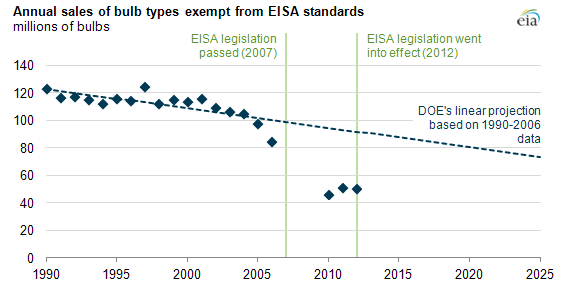
Most specialty light bulb types, like three-way bulbs and appliance bulbs, are exempted from congressionally-legislated energy efficiency standards. But recent shipment data show that sales of these exempt incandescent lamps have declined. This effect points to broader lighting market transformation beyond the target of the original legislation, which was the more common general service bulbs.
The Energy Independence and Security Act of 2007 (EISA) established energy efficiency standards for most general service lamps that produce between 310 and 2,600 lumens of light output, essentially covering incandescent lights using between about 40 and 150 watts of power. Several specialty incandescent bulbs are exempted from the legislation and continue to be available in the marketplace, such as three-way lamps, appliance lamps, shatter-resistance lamps, and rough-service lamps, like those used in garage door openers.
As part of EISA, Congress required the Department of Energy (DOE) to evaluate and publish annual sales estimates of some of the exempt lighting types, starting in 2010. If sales in a given year are double the expected value (based on shipment data from 1990 to 2006), that exempt light type would then be subject to regulatory action.
For most of these exempt types, sales have been lower than expected. Indeed, sales began declining well in advance of the legislation's effective date, which began with brighter bulbs in January 2012 and will be phased in through January 2014.
Although not part of the DOE analysis, the reduced sales of these incandescent specialty bulbs could be attributable to market transformation to more efficient lighting, like compact fluorescent (CFL) and light-emitting diode (LED) bulbs. Several manufacturers offer CFL three-way bulbs to replace incandescent three-way bulbs. LEDs, which do not require filaments or glass enclosures, can be used in applications where shatter-proof or vibration-durable lights are needed.
More information about these exempt lighting types is available on DOE's website.