
Two Wyoming mines accounted for 20% of U.S. coal production by tons in 2012
Note: Powder River Basin coal has a lower thermal content, typically 8,400-8,800 Btu per pound, compared with Eastern coal, which averages 12,000-13,000 Btu per pound.
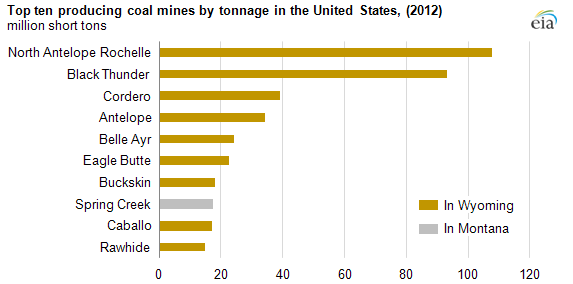
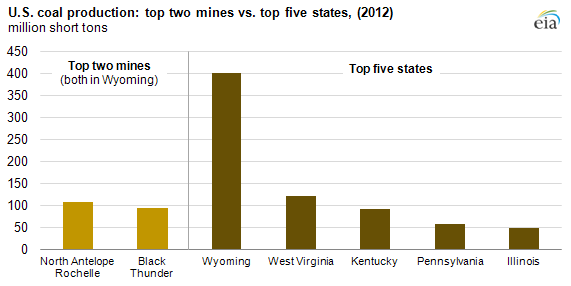
Preliminary coal production data for 2012 show that 9 out of the top 10 producing coal mines in the United States are located in Wyoming; the top two producing mines in Wyoming account for 20% of total U.S. coal production by tonnage. Collectively, the top 10 mines accounted for 38% of total U.S. coal production by tonnage in 2012. Shares of production by energy content for the top mines are somewhat lower since the sub-bituminous coal they produce has lower heat content per ton than bituminous coal produced in other regions.
Note: Powder River Basin coal has a lower thermal content, typically 8,400-8,800 Btu per pound, compared with Eastern coal, which averages 12,000-13,000 Btu per pound.
All of the top 10 producing coal mines in the United States are sub-bituminous, surface mining operations, and each mine is located in the Powder River Basin. The lone mine in the top 10 not located in Wyoming is the Spring Creek Mine in Montana. The nation's top producing mine in 2012 was the North Antelope Rochelle Mine, which produced 108 million short tons, followed by the Black Thunder Mine, which produced 93.1 million short tons. Individually, each of these two mines produced more coal than the entire state of Kentucky (90.6 million short tons), which was the third largest coal producing state in 2012.
Thick beds and large-scale operations make Wyoming's sub-bituminous mines the lowest-cost mines in the United States. EIA's energy production estimates show that coal from Wyoming leads the United States in terms of the energy content, measured in British thermal units (Btu). However, while Wyoming consistently produces the most coal in the United States by volume (401 million short tons in 2012), long rail transport distances, limited coal export capacity, and the lower heat content of sub-bituminous coal limit its use.
Both spot and contract prices for Powder River Basin (PRB) coal are lower than for other coals. Current spot prices for PRB coal are approximately $10.25 per ton. Actual delivered costs tend to be much higher because PRB coal is mostly transported long distances by rail. Transportation and handling charges for PRB coal can be as much as $25-$35 per ton when delivered to markets in the Southeast and the Ohio Valley.
Tags: coal, mining, production/supply, states, Wyoming