
Saudi Arabia was world's largest petroleum producer and net exporter in 2012
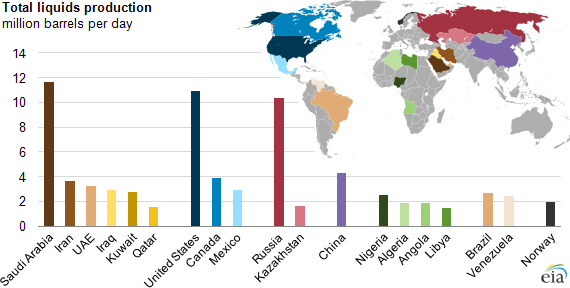
Note: Total petroleum production includes crude oil, natural gas liquids, condensates, refinery processing gain, and other liquids including biofuels.
Saudi Arabia was the world's largest producer and exporter of petroleum and other liquids in 2012, producing an average of 11.6 million barrels per day (bbl/d) and exporting an estimated 8.6 million bbl/d (net). Saudi Arabia produces more than three times as much of these liquids as the next largest member of the Organization of the Petroleum Exporting Countries (Iran), and as much as the rest of the Arab Middle East put together.
In addition to leading the world in production and exports, Saudi Arabia has an estimated 268 billion barrels of proved oil reserves—over 16% of the global total—and is the only country in the world with extensive spare oil production capacity, which can help cushion market disruptions. While Saudi Arabia has about a hundred major oil and natural gas fields, more than half of its proved reserves are contained in eight fields. Saudi Arabia's (and the world's) largest oil field (Ghawar) alone contains an estimated 70 billion barrels of proved reserves, more than the proved reserves in all but seven other countries.
In 2012, 16% of Saudi liquids exports were sent to the United States, accounting for 13% of total U.S. liquids imports. While Canada is the prime supplier of U.S. liquids imports, Saudi Arabia remains an important supplier.
Although leading the world in exports, Saudi Arabia's own liquids consumption is growing. Unlike the United States, Saudi Arabia uses significant amounts of oil for electricity generation, reaching as much as one million bbl/d during hot summer months. Electric demand has doubled since 2000 and is expected to continue its rapid growth. Without initiatives to facilitate fuel switching and increase efficiency, growing volumes of oil—expensive in relation to other fuels—will be consumed domestically.
Finally, as EIA has previously discussed, the choice of accounting conventions for measuring liquids production can also affect which country is considered the world's leading producer at a given date.
For more information, including comprehensive international energy data and analysis, see EIA's recently updated Saudi Arabia Country Analysis Brief.
Tags: Canada, international, liquid fuels, oil/petroleum, Saudi Arabia