
Cushing crude oil inventories rising in 2012
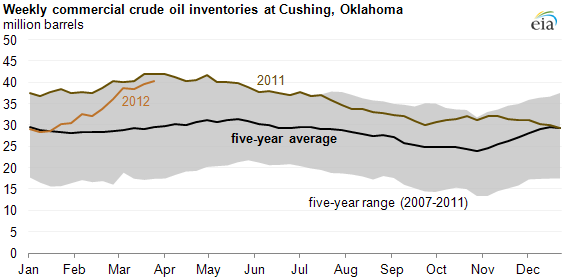
Crude oil inventories at the Cushing, Oklahoma storage hub, the delivery point for the NYMEX light-sweet crude oil futures contract, are up by 12.0 million barrels (43%) between January 13, 2012 and March 30, 2012. This was the largest increase in inventories over an 11-week period since 2009. The inventory builds can be partly attributed to the emptying of the Seaway Pipeline, which ran from the Houston area to Cushing, in advance of its reversal. While Cushing inventories are now approaching the record levels of 2011, the amount of available storage capacity at Cushing is much greater now than it was a year ago, relieving some of the pressure on demand for incremental storage capacity.
Historically, the Seaway Pipeline delivered crude oil from the U.S. Gulf Coast to Cushing, where it then moved to the refineries connected by pipeline to the storage hub. In November 2011, Enbridge Inc. acquired a 50% share in the pipeline from ConocoPhillips; at this time, Enbridge and joint owner Enterprise Product Partners announced they would reverse the direction of the pipeline to flow from Cushing to the Gulf Coast. Currently, the pipeline is expected to deliver 150,000 barrels per day (bbl/d) from Cushing to the Gulf Coast beginning in June 2012. The companies plan to expand Seaway's capacity to 400,000 bbl/d in 2013 and to 850,000 bbl/d in 2014.
In early March, approximately 2.2 million barrels from the Seaway pipeline was emptied into Cushing storage in order to prepare for the pipeline's reversal. This accounts for about 20% of the build in inventories during this period. However, even without the emptying of Seaway, inventory builds over the past months have been particularly steep compared to the five-year average. As of January 13, Cushing inventories stood at 28.3 million barrels, slightly below their seasonal five-year average. After the 12.0-million-barrel increase, inventories were almost 11 million barrels above their average level, the largest such variation to average since June 2011. This is largely due to flows into Cushing as a result of increasing production in the mid-continent region.