
Liquefied natural gas will continue to lead growth in U.S. natural gas exports
Note: LNG=liquefied natural gas
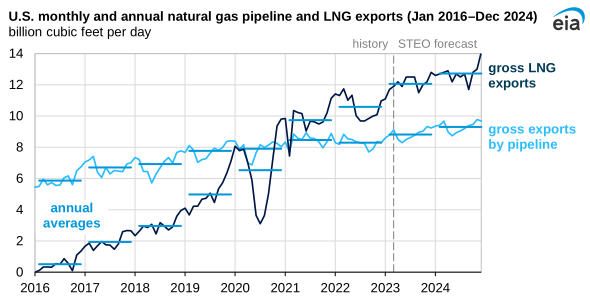
Exports of liquefied natural gas (LNG) will continue to drive growth in U.S. natural gas exports over the next two years, according to our recently released Short-Term Energy Outlook (STEO).
In our March STEO, we forecast that U.S. LNG exports will average 12.1 billion cubic feet per day (Bcf/d) in 2023, a 14% (1.5 Bcf/d) increase compared with last year. We expect LNG exports to increase by an additional 5% (0.7 Bcf/d) next year.
We forecast U.S. LNG exports to rise because of high global demand as LNG will continue to displace pipeline natural gas exports from Russia to Europe. So far this year, mild winter temperatures and fuller-than-average storage resulted in reduced LNG prices, which could be an incentive to import more LNG, especially in the price-sensitive countries of Southeast Asia. The Freeport LNG export terminal's return to service and the new LNG export projects that will commissioned by the end of 2024 support our forecast increase in exports.
Note: LNG=liquefied natural gas
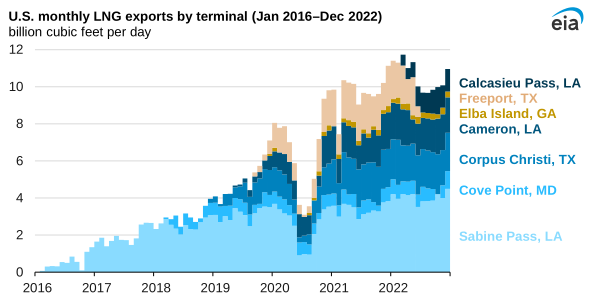
The Freeport LNG terminal is one of seven U.S. LNG export facilities; it can produce 2.14 Bcf/d of LNG on a peak day. Prior to the full shutdown of the facility in June 2022, exports from the facility averaged 1.9 Bcf/d from January 2021 through May 2022, according to our Natural Gas Monthly.
Because of the Freeport shutdown, U.S. LNG exports declined to an average 10.0 Bcf/d from June 2022 through December 2022, after peaking at 11.7 Bcf/d in March. When the new Calcasieu Pass LNG export facility was commissioned, it partially offset the decline in exports from Freeport LNG; exports from Calcasieu Pass have averaged 1.2 Bcf/d since June 2022.
This year, once all three trains at Freeport LNG return to service, we forecast U.S. LNG exports to exceed 12 Bcf/d, and the United States will remain the world’s largest LNG exporter. We forecast that U.S. LNG exports will increase further, to approximately 14 Bcf/d, by December 2024 because some LNG export projects under construction are expected to start operations by then.
We expect U.S. natural gas exports by pipeline to grow by 0.5 Bcf/d in both 2023 and 2024, mainly because of increased exports to Mexico. Several new pipelines in Mexico—Tula-Villa de Reyes, Guaymas-El Oro, the Mayakan pipeline on the Yucatán Peninsula, as well as some other minor interconnects—are scheduled to come online in 2023–24. We also expect an increase in exports via the Sur de Texas-Tuxpan underwater pipeline to supply the proposed floating liquefaction (FLNG) project off the east coast of Mexico.
Principal contributor: Victoria Zaretskaya