
June heat wave in the Northwest United States resulted in more demand for electricity
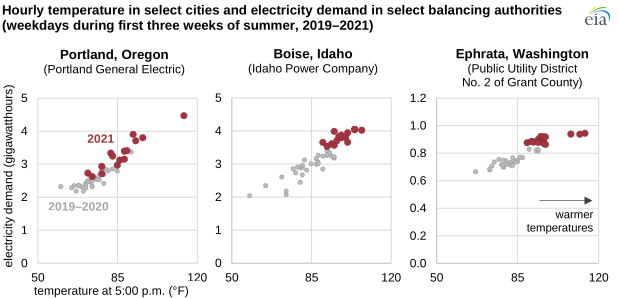
A heat wave in the Northwest United States in late June led to more regional demand for electricity. During periods of high temperatures, electricity demand increases as people turn up their air conditioners, dehumidifiers, fans, and other cooling equipment. Very high temperature events, like the one in June in the Northwest, tend to push electricity demand to very high levels.
In the early summer, temperatures in the Northwest often peak around 5:00 p.m. Even though the sun is directly overhead at noon, temperatures typically don’t reach their highest point until later in the day.
Electricity demand in the early summer often peaks slightly later in the day, often during the hour ending at 6:00 p.m. or 7:00 p.m. Comparing the temperatures and electricity demand on weekdays at 5:00 p.m. in several locations in the Northwest for the first three weeks after the summer solstice shows how electricity demand hit levels much higher than they had in previous years.
For each city discussed below, we used the balancing authority (the local portion of the electric grid) that best matches the location to compare hourly electricity demand to those hourly temperatures. Our Hourly Electric Grid Monitor provides hourly electricity demand and generation data for 64 balancing authorities.
Portland, Oregon: On Monday, June 28, the temperature at Portland International Airport reached an all-time record high of 115°F. At 5:00 p.m., the temperature was 114°F, and electricity demand for the Portland General Electric Balancing Authority for the hour ending at 5:00 p.m. was 4,471 megawatthours (MWh).
Boise, Idaho: On Tuesday, June 29, temperatures in Boise reached 105°F at 4:00 p.m., and as the heat continued, hourly electricity demand reached 4,064 MWh for the hour ending 6:00 p.m. for the Idaho Power Company Balancing Authority. The next day, temperatures reached 104°F at 5:00 p.m., shortly after hourly electricity demand reached 4,067 MWh for the hour ending 2:00 p.m.
Ephrata, Washington: On Tuesday, June 29, temperatures in central Washington reached 116°F, breaking the previous all-time record set on August 4, 1961. On this same day, for the hour ending at 2:00 p.m., the Public Utility District No 2. of Grant County Balancing Authority reported to EIA an hourly electricity demand of 947 MWh.
Principal contributors: Jonathan DeVilbiss, Mark Morey
Tags: consumption/demand, electricity, weather, Northwest