
Lower crude oil prices will mean less exploration and development
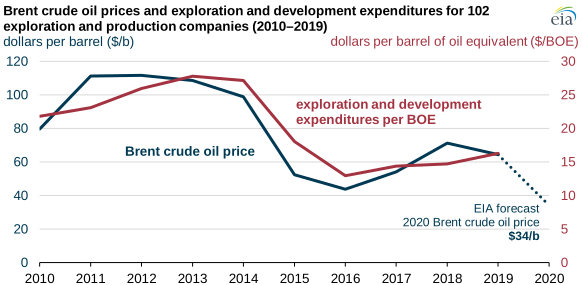
According to the financial reports analyzed by the U.S. Energy Information Administration (EIA), global expenditures related to oil and natural gas exploration and development (E&D) increased $42 billion (13%) for 102 publicly traded oil companies in 2019, totaling $361 billion. As a result of significant crude oil price declines in 2020, however, global proved reserves will likely be revised downward, and E&D expenditures will also likely decline. Several companies have already announced large budget reductions.
EIA based its analysis and its recently published 2019 Financial Review primarily on the published financial reports of 102 publicly traded companies, so the conclusions do not necessarily represent the sector as a whole because the analysis does not include private companies that do not publish financial reports.
According to their financial statements, these 102 companies produced 22.2 billion barrels of oil equivalent (BOE), a measure that reflects their combined production of crude oil and natural gas, and spent $361 billion in E&D. Dividing these companies’ E&D expenditures by their combined production volumes provides a ratio of $16/BOE in 2019, or about one-quarter of the average Brent crude oil price of $64/barrel (b).
In its May Short-Term Energy Outlook, EIA forecasts Brent crude oil prices will average $34/b in 2020. If this crude oil price forecast is realized, E&D expenditures per BOE could fall to less than $10/BOE in 2020 if E&D expenditures remain at about one-quarter of the Brent crude oil price.
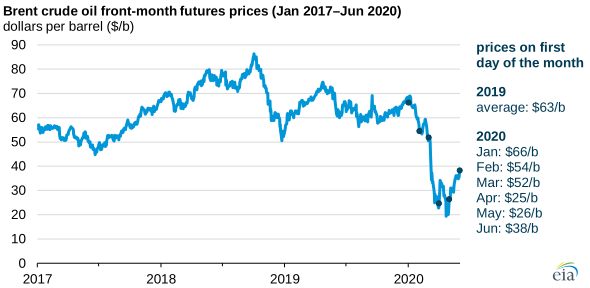
Proved reserves are estimated quantities of oil and natural gas that analysis of geological and engineering data demonstrates with reasonable certainty are recoverable under existing economic and operating conditions. Because crude oil prices directly affect the profitability of E&D projects, changes in the prices companies use to develop their calculation of reserves can significantly affect their proved reserves levels and the volume of reserves they can claim as additions.
The U.S. Securities and Exchange Commission requires companies listed on U.S. stock exchanges to value proved reserves at the end of a year based on the average crude oil prices from the first trading day of each month during that year. On the first trading day of the first six months of 2020, the front-month Brent futures closing price averaged $44/b, or 30% lower than the 2019 full-year average of $63/b.
When crude oil prices decline, oil companies can take impairment charges for assets that fall in value to less than the cost of developing them. Impairment charges represent the decrease in value of assets a company owns, typically its amount of proved reserves. The current low price environment suggests that the 102 companies EIA analyzed will likely post large negative revisions to their proved reserves in 2020.
Principal contributor: Jeff Barron
Tags: prices, liquid fuels, crude oil, oil/petroleum