
Germany announces proposal to phase out coal by 2038, further changing its generation mix
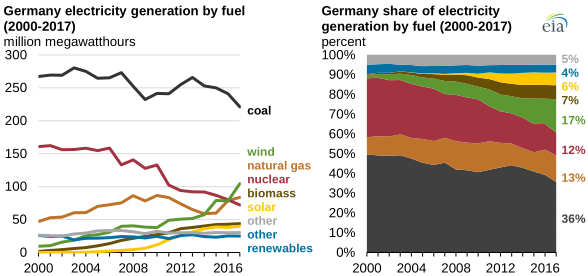
Republished June 5, 2019, to correct the natural gas and nuclear labels on the second graph.
In January 2019, Germany’s government-appointed coal commission introduced a proposed pathway to phase out all coal electricity generation by 2038. This, along with previous actions to phase out nuclear generation, would result in further changes in Germany’s electricity generation mix, which has increasingly used renewable technologies and natural gas. This phaseout is part of the country’s Energiewende—a planned transition to low-carbon domestic energy production.
Electricity generated from Germany’s coal-fired plants declined by 46 million megawatthours (MWh) between 2000 and 2017, while electricity generated from wind and solar increased by 95 million MWh and 40 million MWh, respectively. Despite these changes, coal remains the main source of generation in Germany. Coal’s share of total generation declined from 50% in 2000 to 36% in 2017, despite slight increases in 2012 and 2013 that were related to Germany’s move away from nuclear power.
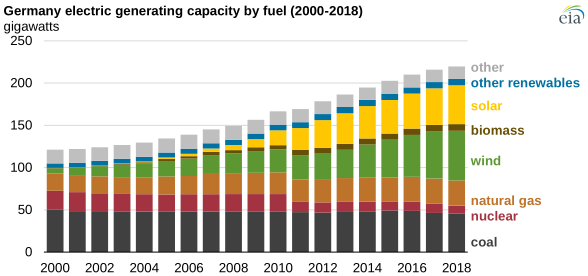
Between 2000 and 2013, Germany’s total electric generating capacity expanded by nearly 100 gigawatts (GW). Additions to wind and solar drove nearly all of this growth, while nuclear, natural gas, and coal-fired capacity declined.
As of March 2019, Germany had about 40 GW of installed coal-fired generation capacity at 84 plants across the country. Of that capacity, 21 GW were fired by bituminous coal—referred to as hard coal by Germany’s Federal Network Agency—and 19 GW by lignite, or brown coal.
The proposed coal phaseout includes initial retirements totaling 13 GW of coal-fired capacity by 2022, with further capacity reductions bringing Germany’s total coal-fired capacity to 17 GW by 2030. One 1.1 GW bituminous coal plant—Dattaln 4—is currently under construction and is expected to be completed in 2020, despite the proposed coal phaseout.
As of March 2019, Germany had 891 onshore and 19 offshore wind turbines in operation, with a total generation capacity of 55.7 GW. More than three-quarters (39.1 GW) of German onshore wind capacity is located in the northern part of the country. Germany also has 5.4 GW of offshore wind capacity in the North Sea and Baltic Sea. Wind turbine capacity growth is expected to slow in 2019 because of the expiration of the government’s 20-year guaranteed support fixed payment, and as older, less profitable onshore wind turbine units are retired.
Germany also has 161 solar plants in operation, with a total capacity of 42.3 GW. Bavaria, a state in southern Germany, contains a quarter of Germany’s total solar generation capacity. In 2018, the European Union removed a tariff on solar panels imported from China, which is expected to spur further increase in solar capacity in Germany.
Principal contributor: Kien Chau
Tags: generation, international, coal, electricity, renewables, capacity