
Output per miner-hour rises as smaller coal mines close
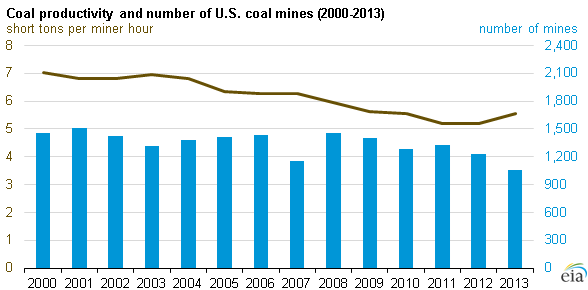
Coal mining productivity increased in 2013, averaging 5.5 short tons per miner hour, reversing a trend of declining productivity since at least 2000. Preliminary data from the Mine Safety and Health Administration indicate a further increase in 2014. Improved productivity at the largest mines, as well as the shrinking number of smaller coal mines, contributed to the rise in overall productivity.
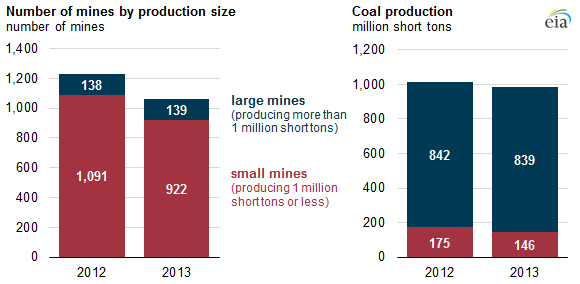
U.S. coal producers improved mining productivity by 6.7% in 2013, reaching 5.5 short tons per miner hour. Nine out of the 14 U.S. coal supply regions, representing 79% of 2013 coal production, showed productivity gains in 2013, the most recent year with detailed productivity statistics. While some productivity gains result from improved mining technology, most of the productivity improvement is attributable to the closing of less-efficient mines with lower labor productivity. There were 14% fewer U.S. coal mines in 2013 than in 2012, falling from 1,228 to 1,061 coal mines. The number of active, producing coal mines in 2013 was the lowest on record, going back to the late 1800s.
Competition from lower natural gas prices, high coal production costs, lower electricity demand, environmental regulations, and weak international coal demand continue to challenge the coal sector and contribute to the idling or closing of the least-efficient mines. Although the number of producing mines varies from year to year, on average the number of producing mines has fallen by an average of 2.4% per year since 2000.
Larger mines tend to have higher productivity: mines producing more than 1 million short tons in 2013 averaged 8.1 short tons per miner hour, while mines producing 1 million tons or less averaged 2.4 short tons per miner hour. Closures of small mines accounted for the entire decline in the number of producing mines, while the number of larger mines was relatively constant from 2012 to 2013. Because smaller mines currently account for a small portion of production (15% in 2013), the closure of these mines had a relatively small impact on total coal production, which fell from 1,017 million short tons in 2012 to 985 million short tons in 2013.
Principal contributor: Diane Kearney
Tags: coal, mining, production/supply