U.S. Energy Information Administration logo
Skip to sub-navigation
August 27, 2014

U.S. liquid fuels production growth more than offsets unplanned supply disruptions
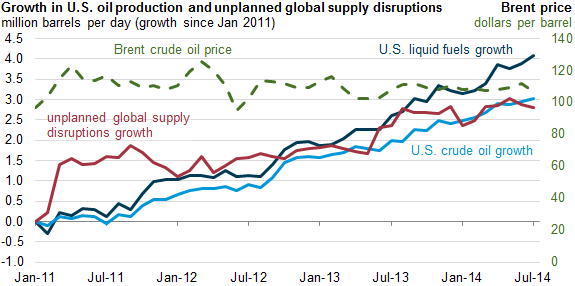
Graph of growth in U.S. oil production and unplanned global supply disruptions, as explained in the article text
Source: U.S. Energy Information Administration, Short-Term Energy Outlook August 2014 and IntercontinentalExchange
Note: The difference between U.S. liquid fuels and crude oil production represents production of hydrocarbon gas liquids, biofuels, and refinery processing gain. Non-OPEC supply disruptions include both crude oil and liquid fuels, while OPEC disruptions include only crude oil. Growth in oil production and supply disruptions represents changes since January 2011.

Record-setting liquid fuels production growth in the United States has more than offset the rise in unplanned global supply disruptions over the past few years, although differences in quality and location suggest that the substitution may not be exactly 1-for-1. U.S. liquid fuels production, which includes crude oil, hydrocarbon gas liquids, biofuels, and refinery processing gain, grew by more than 4.0 million barrels per day (bbl/d) from January 2011 to July 2014, of which 3.0 million bbl/d was crude oil production growth. During that same period, global unplanned supply disruptions grew by 2.8 million bbl/d.

U.S. production growth, the main factor counterbalancing the supply disruptions on the global oil market, has contributed to a decrease in crude oil price volatility since 2011. Over the past 13 months, the monthly average Brent price has moved within a narrow $5 per barrel range, between $107 per barrel and $112 per barrel. In contrast, the range of monthly average Brent prices over the prior 13-month period (June 2012-June 2013) was $21 per barrel.
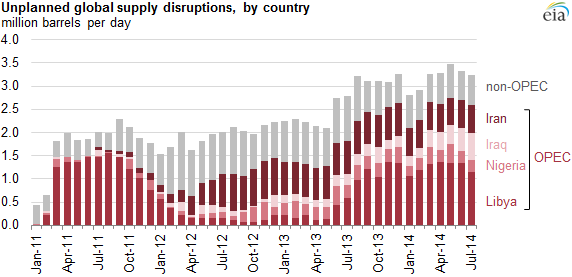
Graph of unplanned global supply disruption volumes by country, as explained in the article text
Source: U.S. Energy Information Administration, Short-Term Energy Outlook August 2014
Note: Non-OPEC supply disruptions include both crude oil and liquid fuels, while OPEC disruptions include only crude oil.

Global unplanned supply disruptions averaged 3.2 million bbl/d during the first seven months of 2014 and peaked at 3.5 million bb/d in May 2014. The current level of supply disruptions is the highest since the Iraq-Kuwait War (1990-91), when supply disruptions peaked at 4.3 million bbl/d, based on data from the International Energy Agency.

Principal contributor: Asmeret Asghedom

Statistics
Analysis
Tools
Education
News

Petroleum & Other Liquids

Crude oil, gasoline, heating oil, diesel, propane, and other liquids including biofuels and natural gas liquids.

Natural Gas

Exploration and reserves, storage, imports and exports, production, prices, sales.

Electricity

Sales, revenue and prices, power plants, fuel use, stocks, generation, trade, demand & emissions.

Coal

Reserves, production, prices, employment and productivity, distribution, stocks, imports and exports.

Nuclear & Uranium

Uranium fuel, nuclear reactors, generation, spent fuel.

Renewable & Alternative Fuels

Includes hydropower, solar, wind, geothermal, biomass and ethanol.

EIA Survey Forms

Forms EIA uses to collect energy data including descriptions, links to survey instructions, and additional information.

Total Energy

Comprehensive data summaries, comparisons, analysis, and projections integrated across all energy sources.

U.S. States

State energy information, including overviews, rankings, data, and analyses.

International

International energy information, including overviews, rankings, data, and analyses.

Environment

Greenhouse gas data, voluntary reporting, electric power plant emissions.

Data Tools, Apps, & Maps

Tools to customize searches, view specific data sets, study detailed documentation, and access time-series data.

Open Data

EIA's free and open data available as API, Excel add-in, bulk files, and widgets

EIA Beta

Come test out some of the products still in development and let us know what you think!

Open Source Code

EIA's open source code, available on GitHub.

RSS Feeds

Subscribe to feeds for updates on EIA products including Today in Energy and What's New.