
Dark spreads measure returns over fuel costs of coal-fired generation
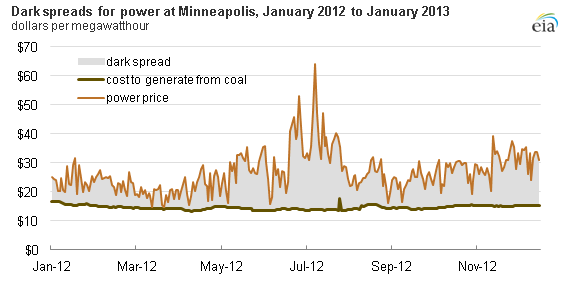
Note: Dark spreads are calculated using the MISO Minnesota Hub on-peak and off-peak power prices, prompt-month futures contracts for Powder River Basin Wyoming coal with an energy content of 8,800 Btu/lb and a sulfur content of 0.8 lb/MMBtu, a 10,000-Btu/kWh heat rate, and a $17/ton coal transportation rate.
The dark spread is a common metric used to estimate returns over fuel costs of coal-fired electric generators. A dark spread is the difference between the price received by a generator for electricity produced and the cost of coal needed to produce that electricity. Dark spreads can be calculated using current spot prices or forward prices.
Dark spreads are meant to convey the relative profitability of a coal-fired electric generator and reflect the role traditionally played by a coal-fired unit in an electric system as well as the way coal is purchased at electric power plants. The calculation can be grouped into two main parts: the power price and the fuel costs.
Dark spread calculation:

Power price
Unlike spark spreads, which are calculated using natural gas costs and on-peak power prices, dark spreads often use a combination of on- and off-peak power prices. The combination of power prices (referred to as a flat price) reflects the different role that coal-fired generators play in the supply stack of a particular electric system. Coal-fired generators have traditionally served as baseload generation–they run throughout the day and night. The combination of on-peak (during the day) and off-peak (nights and weekends) power prices reflects this role.
Fuel costs
Coal is often purchased in long-term contracts that have prices not readily available to the public (unlike natural gas prices, which often track closely with spot prices that are publicly available). Analysts sometimes substitute the prompt-month futures contract for a type of coal that is commonly consumed by generators in a particular region. These prices are readily available and reflect the current price of the commodity, rather than the terms of a contract that could be several years old.
Because the prompt-month contract price is for a specific fuel only, a transportation cost is added to reflect the price of shipping the coal to the power plant. Analysts usually select coal trading points and transportation costs that match the location for the electric market clearing price used in the dark spread calculation.
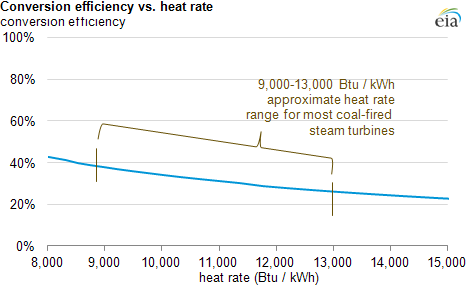
Another key component of the dark spread equation is the heat rate, or measure of the efficiency of the generating unit. The heat rate assumption in the chart above was a generic 10,000 Btu/kWh coal-fired steam turbine. A generator that uses 10,000 Btu to produce one kWh has a conversion efficiency of slightly above 30% (see chart below). More-efficient combined-cycle units that burn natural gas have heat rates of 7,000 Btu/kWh (these are often used as the assumption in spark spread calculations).
A generic dark spread calculation has similar limitations to the spark spread, as it does not take into consideration other costs associated with generating electricity such as finance charges, environmental costs (although those are sometimes added), and other variable costs (like operations and maintenance costs), or taxes. In that sense the dark spread, like the spark spread, is a general but not precise indicator of the returns over fuel cost of a particular existing generating plant.
Tags: coal, electricity, generation, prices