Menu
Crude oil, gasoline, heating oil, diesel, propane, and other liquids including biofuels and natural gas liquids.
Exploration and reserves, storage, imports and exports, production, prices, sales.
Sales, revenue and prices, power plants, fuel use, stocks, generation, trade, demand & emissions.
Energy use in homes, commercial buildings, manufacturing, and transportation.
Reserves, production, prices, employment and productivity, distribution, stocks, imports and exports.
Includes hydropower, solar, wind, geothermal, biomass and ethanol.
Uranium fuel, nuclear reactors, generation, spent fuel.
Comprehensive data summaries, comparisons, analysis, and projections integrated across all energy sources.
Monthly and yearly energy forecasts, analysis of energy topics, financial analysis, congressional reports.
Financial market analysis and financial data for major energy companies.
Greenhouse gas data, voluntary reporting, electric power plant emissions.
Maps, tools, and resources related to energy disruptions and infrastructure.
State energy information, including overviews, rankings, data, and analyses.
Maps by energy source and topic, includes forecast maps.
International energy information, including overviews, rankings, data, and analyses.
Regional energy information including dashboards, maps, data, and analyses.
Tools to customize searches, view specific data sets, study detailed documentation, and access time-series data.
EIA's free and open data available as API, Excel add-in, bulk files, and widgets
Come test out some of the products still in development and let us know what you think!
EIA's open source code, available on GitHub.
Forms EIA uses to collect energy data including descriptions, links to survey instructions, and additional information.
Sign up for email subscriptions to receive messages about specific EIA products
Subscribe to feeds for updates on EIA products including Today in Energy and What's New.
Short, timely articles with graphics on energy, facts, issues, and trends.
Lesson plans, science fair experiments, field trips, teacher guide, and career corner.
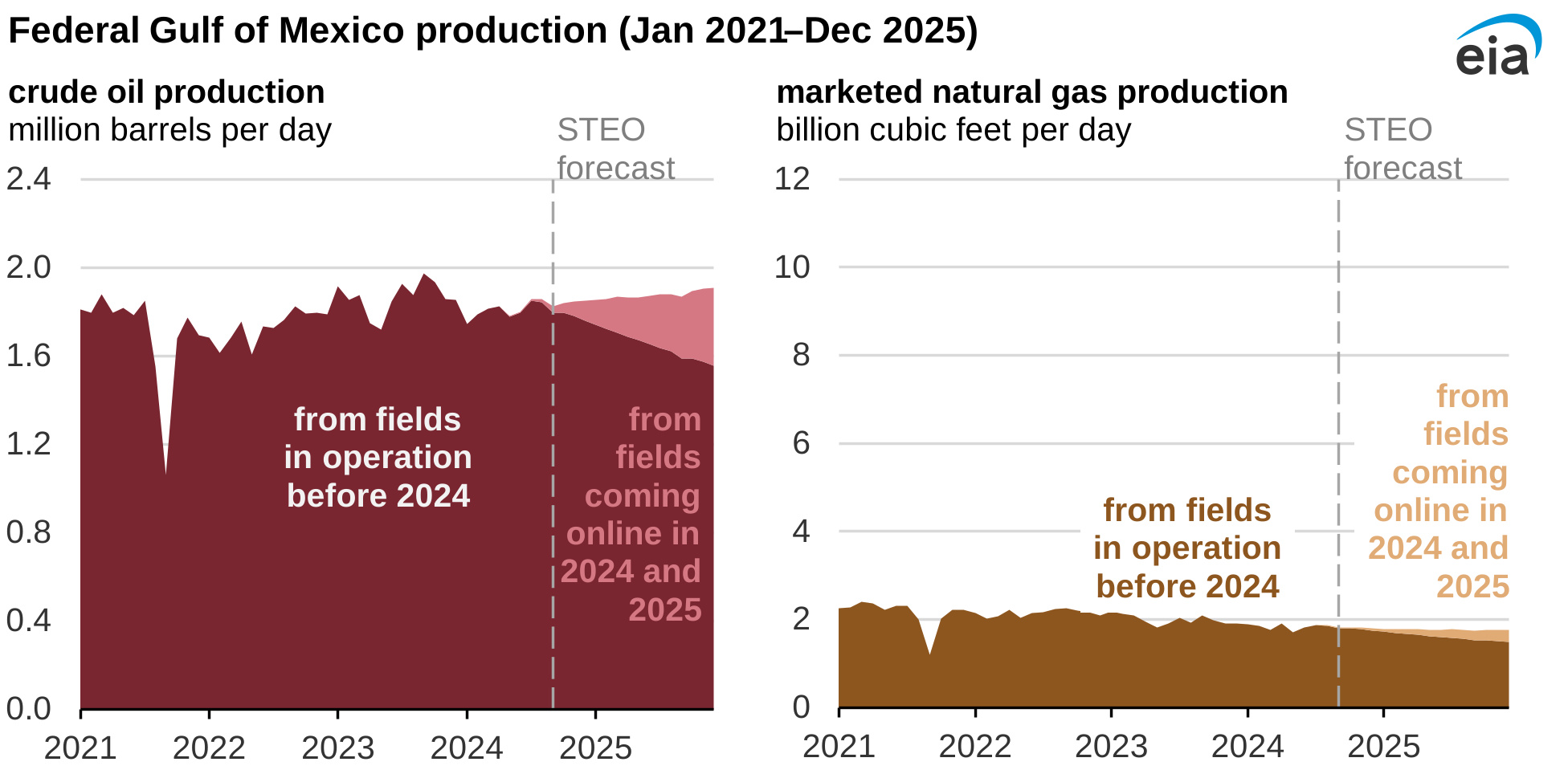
We recently implemented a new model for forecasting crude oil and natural gas production from the U.S. Federal Offshore Gulf of Mexico (GOM) in the Short-Term Energy Outlook (STEO). In our latest outlook, we forecast that GOM production will remain relatively flat with new fields offsetting the natural production declines from existing fields.
We forecast that 1.8 million barrels per day (b/d) of crude oil will be produced in the GOM in 2024 and 1.9 million b/d in 2025, compared with 1.9 million b/d in 2023. We expect GOM natural gas production to average 1.8 billion cubic feet a day (Bcf/d) in both 2024 and 2025, compared with 2.0 Bcf/d in 2023. At these volumes, the GOM would contribute about 14% of U.S. oil production and 2% of U.S. marketed natural gas production.
We expect 12 new fields to start production in the GOM during 2024 and 2025, without which we would expect GOM production to decline. Seven of these fields will be developed using subsea tiebacks, or underwater extensions from existing Floating Production Units (FPUs) at the surface. We expect four new FPUs, which would produce crude oil and natural gas from five more fields. We expect that fields that have already started in 2024 will contribute 22,000 b/d of crude oil production in 2024, and fields that will start production in 2024 or 2025 will contribute 231,000 b/d on average in 2025 as additional production comes online and ramps up.
For more information on our new model, our forecast and supporting assumptions, and new infrastructure coming online, please refer to our recently released article, EIA expects flat oil and natural gas production from the Gulf of Mexico after model update.
Principal contributor: Eulalia Munoz-Cortijo
Tags: forecasts/projections, natural gas, STEO (Short-Term Energy Outlook), liquid fuels, crude oil, oil/petroleum, production/supply, Gulf of Mexico