
Natural gas venting and flaring in North Dakota and Texas increased in 2019
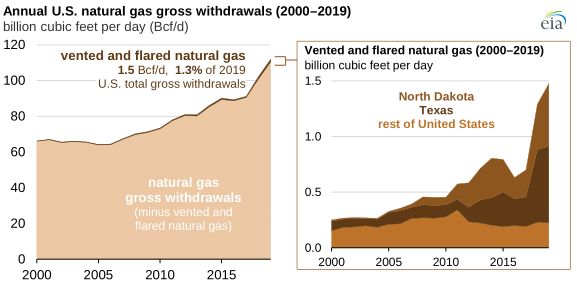
Note: The Natural Gas Annual relies on vented and flared natural gas data reporting by the states, and some states do not collect or publish any data on vented and flared amounts.
The U.S. Energy Information Administration’s (EIA) 2020 Natural Gas Annual reports that the volume of U.S. natural gas that was vented and flared in 2019 was 1.48 billion cubic feet per day (Bcf/d), a record high annual average. The percentage of U.S. natural gas that was vented and flared in 2019 increased to 1.3% of gross withdrawals, the highest share recorded in EIA data. As crude oil production has outpaced the construction of necessary infrastructure to transport the natural gas extracted during oil production, or associated natural gas, it has been increasingly vented and flared.
Natural gas flaring is a controlled burn of natural gas at the wellhead using a dedicated flare that ignites the methane component in natural gas. Venting is the direct release of natural gas into the atmosphere, which is often restricted by state regulators. Regulators prefer flaring when possible because the methane released as a result of venting is a more potent greenhouse gas than the carbon dioxide released as result of flaring.
In 2019, North Dakota and Texas combined accounted for 85%, or 1.3 Bcf/d, of the reported U.S. vented and flared natural gas. Texas accounted for 47% and North Dakota accounted 38% of the total U.S. vented and flared natural gas. State agencies in Texas and North Dakota are working with oil producers to limit the need for flaring without shutting down or affecting crude oil production from new wells. Venting is banned in North Dakota and restricted in Texas.
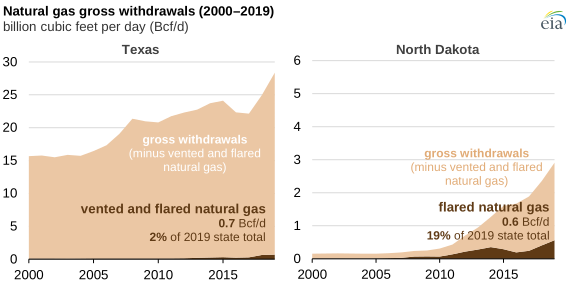
The Bakken play accounts for 93% of all crude oil and 98% of all natural gas produced in North Dakota. Natural gas production from the Bakken play grew from 0.2 Bcf/d in 2010 to nearly 2.9 Bcf/d in 2019. During this time, natural gas processing plant capacity and pipeline capacity have not kept pace with the growth in natural gas production. In 2019, flared natural gas in North Dakota totaled 0.6 Bcf/d, up from 0.4 Bcf/d in 2018. The percentage of total natural gas gross withdrawals that was flared in North Dakota increased from 17% to 19% from 2018 to 2019, the highest percentage of any state.
In Texas, growing crude oil production from the Permian Basin and Eagle Ford plays has contributed to a rapid increase in natural gas flaring in recent years. In 2019, vented and flared natural gas in Texas increased to 0.7 Bcf/d, about 2.4% of total 2019 natural gas gross withdrawals production in the state. The 2019 percentage of vented and flared natural gas is down from the 2018 high of 2.6%.
Principal contributor: Emily Geary
Tags: natural gas, Texas, states, North Dakota