
U.S. refinery runs hit fifth consecutive annual record high in 2018
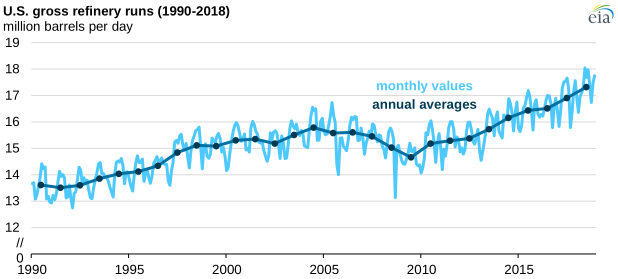
Gross inputs to U.S. petroleum refineries, also referred to as refinery runs, averaged 17.3 million barrels per day (b/d) in 2018, the highest annual average on record and the fifth consecutive year of record-high refinery runs. Refinery runs peaked in June at an average of 18.0 million b/d, with average weekly runs exceeding 18.0 million b/d during six weeks in 2018.
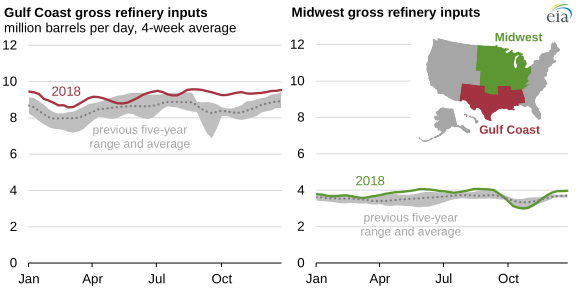
High refinery diesel margins—the difference between the acquisition price of crude oil and the wholesale price of diesel fuel—have provided an incentive for refiners to maintain high runs despite low gasoline refinery margins. The record-high U.S. gross refinery input levels are driven in large part by refinery operations in the Gulf Coast and Midwest regions (Petroleum Administration for Defense Districts, or PADDs, 3 and 2, respectively).
In the Gulf Coast, which is home to more than half of all U.S. refinery capacity, refinery runs averaged more than 9.2 million b/d in 2018, 8% higher than the previous five-year average for that region and the first time the annual average surpassed 9.0 million b/d. The Midwest has the second-highest refinery capacity, and refinery runs averaged 3.8 million b/d in 2018, or 6% higher than the previous five-year average.
Refinery utilization as a percentage of operable capacity averaged 93.2% in 2018, an increase of about 2.1% from 2017. Despite record-high inputs, utilization rates have not surpassed the record of 95.6% set in 1998. Rather than running at higher utilization rates, refineries have increased their capacity: U.S. refinery capacity increased by 783,000 barrels per calendar day between December 2013 and December 2018.
In the March update of its Short-Term Energy Outlook, EIA expects U.S. refinery runs in 2019 to be relatively flat compared with the record-high 2018 levels, partially as a result of expected high levels of refinery maintenance in 2019. Refinery runs are then expected to increase and reach a new record of 17.8 million b/d in 2020.
Principal contributors: Emily Sandys, Matthew French