
Expected decrease in Lower 48 oil production is partially offset by rising GOM output
Note: Includes lease condensate.
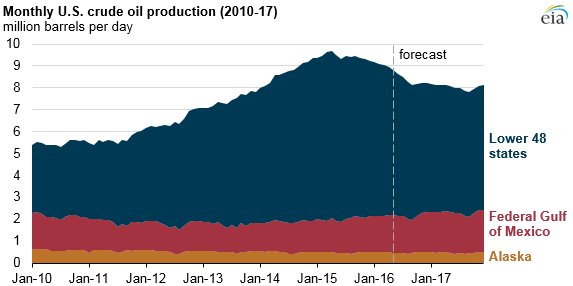
In response to continued low oil prices, onshore crude oil production in the Lower 48 states is expected to decline from an average of 7.41 million barrels per day (b/d) in 2015 to 6.46 million b/d in 2016 and to 5.76 million b/d in 2017. Increased production from the federal Gulf of Mexico (GOM) is not enough to offset those declines, with total projected U.S. production falling from 9.43 million b/d in 2015 to 8.04 million b/d in 2017.
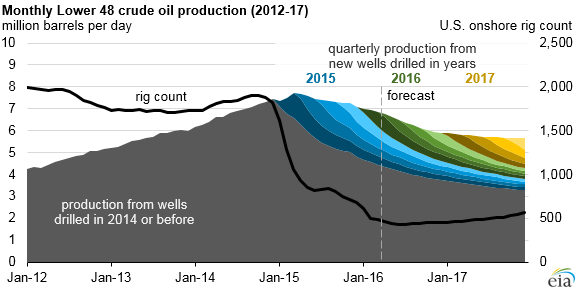
The sharp decline in oil prices since the fourth quarter of 2014 has had a significant effect on drilling in the United States. The number of active onshore drilling rigs in the Lower 48 states fell 78% (from 1,876 to 412) between the weeks ending on October 31, 2014, and April 15, 2016, according to data from BakerHughes. The decline in active rigs and well completions is projected to result in month-over-month onshore oil production declines of 120,000 b/d through September 2016.
Market expectations of uncertainty in the crude oil price outlook continue to be high, as reflected in the current values of futures and options contracts. In EIA's April Short-Term Energy Outlook (STEO), the 95% confidence interval for market expectations for prices in December 2017 is relatively wide, with upper and lower limits of $20 per barrel (b) and $100/b, respectively. EIA's April STEO forecasts Brent crude oil prices averaging $35/b in 2016 and $41/b in 2017, with the December 2017 price averaging $45/b.
EIA projects that the number of operating rigs in the Lower 48 states will continue to decrease through mid-2016 before beginning to slowly increase. However, expected Lower 48 production will continue to decline—although at a slowing rate—throughout 2017.
In contrast to the forecast of declining Lower 48 onshore production through 2017, federal Gulf of Mexico oil production is projected to increase from 1.54 million b/d in 2015 to 1.66 million b/d and to 1.82 million b/d in 2016 and 2017, respectively. Alaska's oil production is projected to slightly decrease from 0.48 million b/d in 2015 to 0.47 million b/d in 2016 and to 0.46 million b/d in 2017.
Principal contributors: Danya Murali, Jason Worrall