
First-quarter 2011 coal share of power generation lowest in over 30 years
Note: Data for 2010 and January-May 2011 are preliminary. Data for June 2011 are estimates used in the STEO.
Download CSV Data
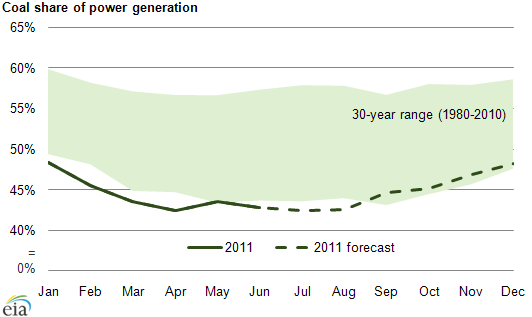
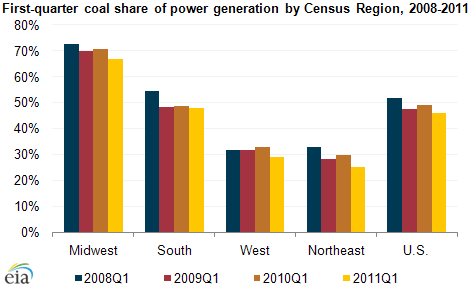
The share of electricity generated by coal during the first three months of this year was at its lowest first-quarter level in more than 30 years. The U.S. electric power sector generated about 440 terawatthours (TWh) using coal during the first quarter of 2011, which is 26.5 TWh less than the amount generated during the first quarter of 2010—despite the fact that the overall total level of generation in the United States increased by less than 1%. The amount of coal-fired generation in the first quarter of 2011 corresponds to a 46% share of total generation, which is 3 percentage points lower than the same period last year and 6 percentage points lower than the first quarter of 2008.
The decline in the share of generation provided by coal is offset by increased generation fueled by other energy sources, particularly natural gas. In the eastern U.S., the spot price of coal has risen steadily for nearly two years, while natural gas prices have remained comparatively low. This disparity in fuel costs has contributed to the decline in coal's fuel share even in the Midwest Census Region (see map), where coal has historically been the dominant fuel used in the electric power sector. During the first quarter of 2011, coal's share of generation in the Midwest fell from 70.5% in 2010 to 66.9%, while the region's fuel share for natural gas gained 2 percentage points.

In the South Census Region, the coal share of generation decreased from 54.5% during the first quarter of 2008 to 47.7% during the same period this year. The Northeast and West Census Regions are much less dependent on coal; their first-quarter 2011 coal shares were 24.9% and 29.0% (respectively), a decrease of 8.0 percentage points in the Northeast and 2.6 percentage points in the West from the same period in 2008.
Note: Data for 2010 and 2011 are preliminary.
Preliminary data and estimates for the second quarter show an increase in the coal share of generation. Nuclear power plant outages in April, May, and June required some coal plants to increase their output to meet baseload demand.
Tags: coal, natural gas, nuclear