
Oil exploration in the U.S. Arctic continues despite current price environment
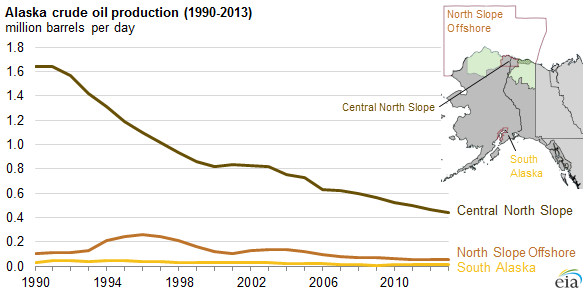
Alaska's crude oil production has declined from 1.8 million barrels per day (MMb/d) in 1991 to 0.5 MMb/d in 2014, and it is expected to continue declining through 2040. Almost 75% of Alaska's crude oil production from 1990 to 2012 was from the Prudhoe Bay and Kuparuk River fields in the central North Slope, which respectively produced 4.9 billion and 1.7 billion barrels of crude oil over this period.
Crude oil production in Alaska is sensitive to the challenging environment—including variable ice conditions and limited time without ice coverage—as well as pipeline economics. However, recent conditional approval granted to Royal Dutch Shell to begin exploratory drilling in the Burger Prospect in the Chukchi Sea may help to offset future declines in crude oil production from other state and federally managed resources in the region.
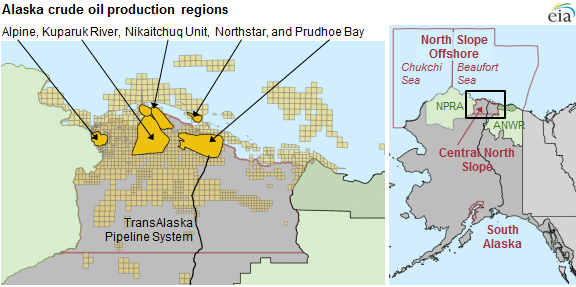
Current Alaska oil and natural gas activity is concentrated in three main regions: North Slope Offshore, Central North Slope, and South Alaska.
- The North Slope Offshore encompasses the Chukchi and Beaufort Seas. Except for the Northstar field, which spans both federal and state waters in the Beaufort Sea, most of the production, including the Nikaitchuq field and other smaller producing fields, is located in state waters in the Beaufort Sea.
- The Central North Slope includes the Alpine, Kuparuk River, Milne Point, Prudhoe Bay, and West Sak fields, as well as the National Petroleum Reserve-Alaska (NPR-A) and the Arctic National Wildlife Refuge (ANWR). According to the Bureau of Land Management (BLM), there are 212 oil and natural gas leases in the NPR-A but no producing units. Oil and natural gas exploration and production are not allowed in the ANWR.
- In South Alaska, ongoing oil and natural gas activity is located in the Cook Inlet area.
The Bureau of Ocean Energy Management estimates that the Chukchi Sea, off the northwest coast of Alaska, contains 2 to 40 billion barrels of unproved technically recoverable crude oil resources and 10 to 210 trillion cubic feet of unproved technically recoverable natural gas resources. Technically recoverable resources include oil and natural gas that can be produced based on current technology, industry practice, and geologic knowledge. More than half of Alaska's unproved technically recoverable crude oil resources are in the North Slope Offshore.
The unproved technically recoverable crude oil resources in the North Slope Offshore (23.8 billion barrels) are comparable to the unproved technically recoverable crude oil resources in the Bakken formation (22.8 billion barrels) and more than twice the unproved technically recoverable crude oil resources in the Eagle Ford formation (10.3 billion barrels).
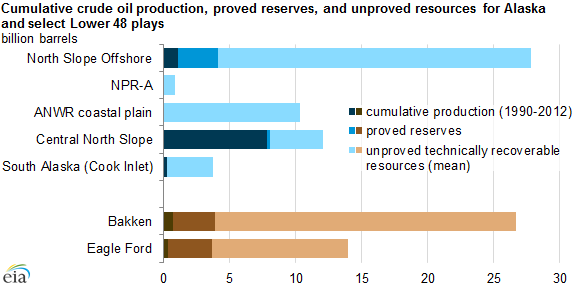
Note: Proved reserves as of Jan. 1, 2013. Unproved resources as of Jan. 1, 2013 for Eagle Ford and Bakken; unproved resources for Alaska from the Alaska's 2014 report.
Note: Bakken and Eagle Ford are in the Lower 48 states.
Principal contributors: Terry Yen, Laura Singer
Tags: Alaska, crude oil, liquid fuels, map, resources