
2013 completions of large solar thermal power plants mark technology gains
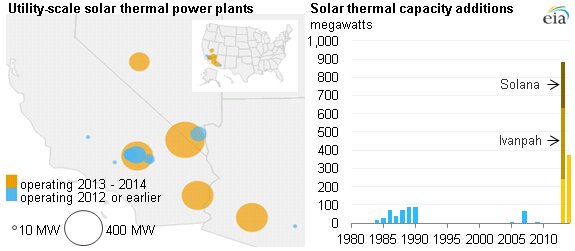
Note: This map excludes generators for which solar thermal energy is not used as the primary energy source, such as the 75-MW Martin Solar Energy Center, which connects a parabolic trough field to an existing natural gas combined-cycle plant.
Republished November 14, 2013, 1:08 p.m. to add a legend to the graph.
Several large, new solar thermal power plants are expected to begin commercial operation by the end of 2013, more than doubling the solar thermal generating capacity in the United States. The projects use different solar thermal technologies and storage options. Abengoa's Solana plant, which came on line in October 2013, is a 250-megawatt (MW) parabolic trough plant in Gila Bend, Arizona with integrated thermal storage. BrightSource's Ivanpah, expected to enter service by the end of 2013, is a 391-MW power tower plant in California's Mojave Desert and does not include storage.
Solana and Ivanpah are much larger than solar thermal plants that have previously entered service in the United States. Over the past decade, a few smaller-scale and demonstration solar thermal projects have entered service. The only other dedicated solar thermal plants larger than 10 MW in the United States are the series of Solar Energy Generating System (SEGS) plants built in California in the 1980s and early 1990s and the Nevada Solar One parabolic trough project completed in 2007.
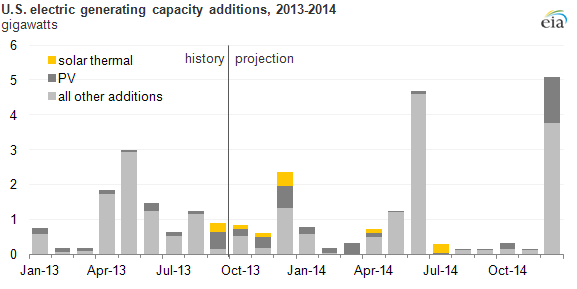
EIA projections for total solar thermal capacity additions in 2013 and 2014 include six projects for a total of 1,257 MW, with more expected in 2015 and 2016. However, while these solar thermal capacity additions are significant for the technology, they represent only 4% of total expected capacity additions for 2013 and 2014 (see chart below). Solar thermal capacity additions also continue to be outpaced by solar photovoltaic (PV) capacity additions, even though solar PV has only meaningfully entered the utility-scale market in the past few years.
The tabs below describe the solar thermal technologies at Solana and Ivanpah, as well as Solana's storage deployment.
Source: U.S. Department of Energy, Loan Guarantee Program Office
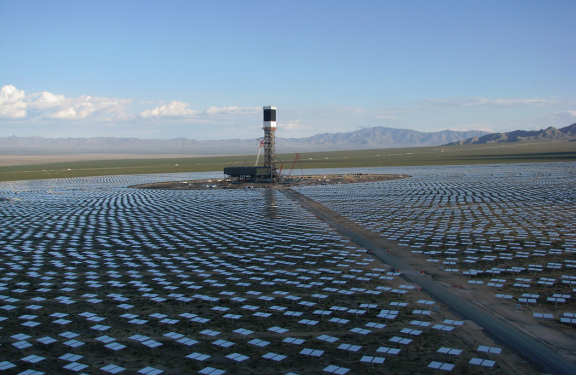
Ivanpah, which is expected to come on line by the end of 2013, uses a series of three power towers: a field of movable mirrors (heliostats) focusing light on a 459-foot central tower. The light heats water in a boiler at the top of the tower, creating steam, which is used to run a conventional steam turbine like those in a typical fossil-fired power plant.
Source: Abengoa, used with permission
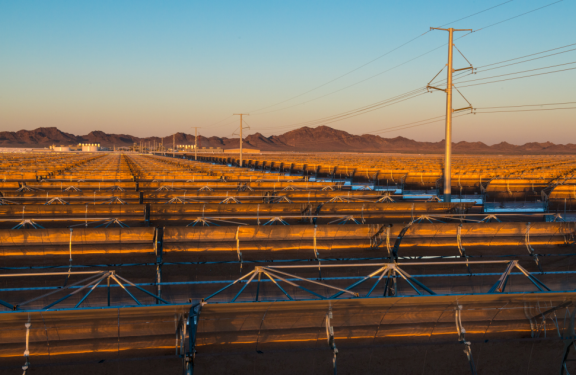
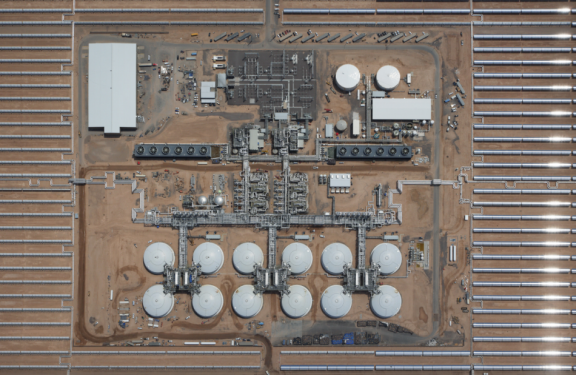
Solana, which began delivering electricity to the grid outside Phoenix, Arizona, uses parabolic, mirrored troughs to collect sunlight, as well as thermal storage, allowing the plant to operate up to six hours on stored energy alone. The parabolic troughs are movable, tracking the sun and focusing sunlight onto a tube running down the center of each trough, which contains a heat transfer fluid. A heat exchanger creates steam that in turn runs a conventional steam turbine. (See additional resources on solar thermal technologies and images of Solana.)
Source: Abengoa, used with permission
Solana stores some of the sun's energy as heat, using a molten salt as the thermal medium. The molten salt is stored in the round tanks, seen at the bottom center of this overhead image of Solana. This storage capability sets the plant apart from photovoltaic or wind technologies, which are dependent on the immediate availability of the sun or wind. With storage, Solana can operate while clouds pass overhead, providing a predictable supply of power to the grid. It can continue to produce electricity for up to six hours after the prime hours of sunlight have passed. This flexibility is particularly important as demand for electricity often peaks in the early evening. Storage technology was critically important in the development of Solana's 30-year power purchase agreement with Arizona Public Service (the largest utility in Arizona), which will buy all of Solana's output.
Both parabolic trough and power tower technologies can be integrated with varying levels of thermal storage. For example, the Crescent Dunes solar thermal power tower plant near Tonopah, Nevada that is expected to come on line by the end of 2013 will include 10 hours of thermal energy storage.
All five of the major solar thermal projects—including Solana and Ivanpah—that are scheduled to come on line in 2013 and 2014 were awarded loans through the U.S. Department of Energy's Loan Guarantee Program. Solana received a federal loan guarantee for $1.45 billion of the approximately $2 billion cost of the project, according to the parent company, Abengoa. BrightSource Energy reports a $1.6 billion federal loan guarantee on the approximately $2.2 billion Ivanpah project.
Principal contributors: Marie Rinkoski Spangler, Gwen Bredehoeft
Tags: capacity, electricity, generating capacity, map, renewables, solar