
EIA’s upcoming Residential Energy Consumption Survey will collect data from all 50 states
In September, the U.S. Energy Information Administration (EIA) launched data collection for the 2020 Residential Energy Consumption Survey (RECS) to provide estimates of household energy use in all 50 states and the District of Columbia. Most of the earlier iterations of EIA’s survey of residential energy use provided state-level estimates for only the four largest states.
EIA initiated the RECS program in 1978 and has conducted the survey periodically; the most recently published survey provides residential energy consumption estimates for 2015. The 2020 RECS will be the 15th time EIA has conducted the study. The RECS is a two-part data collection. The first part is a household survey, which collects characteristics about basic home structure, appliances and electronics, space heating and air conditioning, water heating, lighting, and items related to household energy insecurity. The second part involves contacting those households’ energy suppliers to collect energy consumption and cost data.
The 2020 RECS includes several changes from previous RECS surveys. The 2020 RECS household survey will be entirely self-administered. Instead of trained interviewers conducting in-person surveys, EIA will survey respondents through web-based and paper-based surveys. In 2014 and 2015, EIA conducted pilot studies to examine the feasibility of self-administered surveys, which led to the full incorporation of the self-administered mode for the 2020 RECS. The lower cost of self-administered surveys relative to in-person surveys allowed EIA to increase the sample size of the survey.
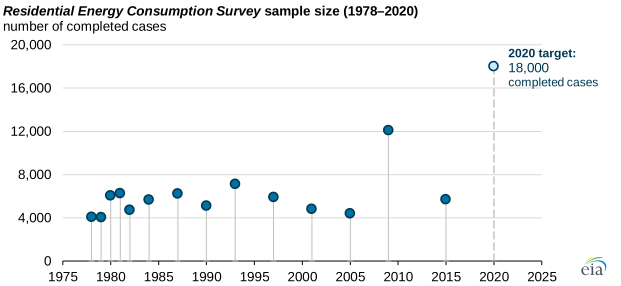
The 2020 RECS will have the largest sample size in RECS history: EIA is targeting 18,000 completed cases to produce estimates of energy consumption and expenditures for all 50 states and the District of Columbia. Previous RECS targeted consumption estimates at national, regional, and divisional levels (based on U.S. Census Bureau regions and divisions). The 2009 RECS, aided by a temporary funding increase from the American Recovery and Reinvestment Act of 2009, increased the sample size to about 12,000 completed cases and allowed EIA to provide state-level estimates for 16 states.
EIA uses the information from these surveys, along with external data such as weather data, to produce end-use estimates such as space heating consumption and air conditioning costs.
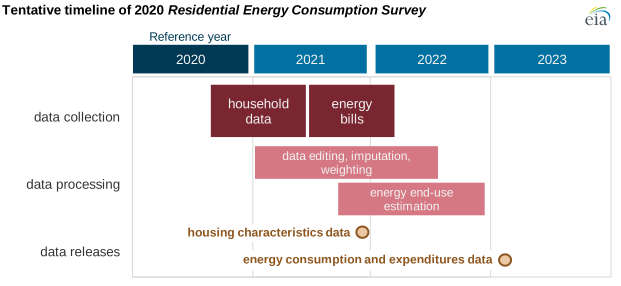
The RECS household survey data collection began in September 2020 and will conclude in spring 2021. EIA plans to release initial estimates on key household characteristics in late 2021. EIA’s final state-level energy consumption and expenditure data, as well as survey microdata, will be available in early 2023.
Principal contributor: Grace Deng