




Alternative Fuel Vehicle Data 2017
The U.S. Energy Information Administration (EIA) publishes historical annual data for 2002 through 2017 on the number of alternative fuel vehicles (AFV) in inventory for four types of vehicle fleets: federal government, state governments, transit agencies, and fuel providers.
The data include supply of AFV, gasoline-electric hybrid vehicles, and diesel-electric hybrid vehicles from two types of suppliers: original equipment manufacturers and aftermarket vehicle converters. No newer data are available because EIA has discontinued the Annual Survey of Alternative Fueled Vehicles, Form EIA-886.
More recent data on AFV are published in Oak Ridge National Laboratory’s Transportation Energy Data Book; see Chapter 6: Alternative Fuel and Advanced Technology Vehicles and Characteristics.
Federal agencies
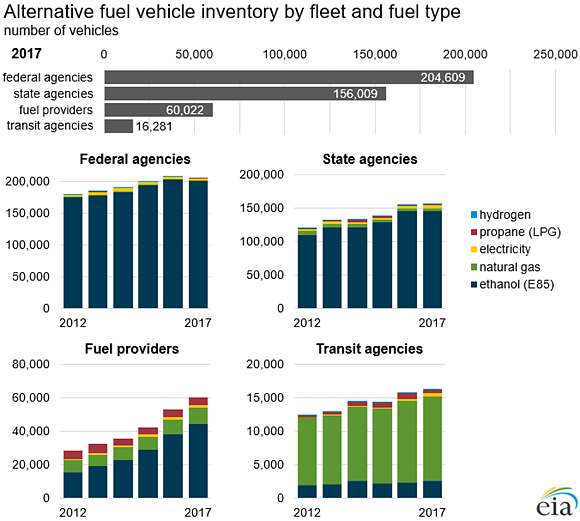
In 2017, the federal fleet maintained nearly 205,000 AFVs, and 98% of these vehicles were E85-capable flexible fuel automobiles, SUVs, and trucks. The U.S. Postal Service accounted for nearly 46,000 of the 200,000 E85 vehicles in the fleet, and the U.S. Department of Homeland Security accounted for slightly more than 21,000 E85 vehicles. E85-capable vehicles have historically been the most widely available AFV for fleets to meet the federal mandates and executive orders that require AFV acquisition and alternative fuel use.
State agencies
State agencies have similar shares of vehicle types as the federal government. Most of the 156,000 AFVs in total state fleets are light-duty vehicles, and 93% are E85 capable. Similar to the federal fleets, state agencies tend to use flexible fuel vehicles to save money at the pump and to reduce the affect that state fleets have on energy consumption and the environment. Overall growth in AFVs also stems from the EPAct requirements to add AFVs to their fleets, established in the State and Alternative Fuel Provider Fleet Program.
Transit agencies
Transit agencies primarily have heavy-duty buses for mass transit in metropolitan areas. Of all alternative fuel buses in use, natural gas is by far the most prevalent fuel in fleets. In 2017, transit agencies reported an inventory of 16,000 AFVs, and about 12,000 of those AFVs were heavy-duty buses that consumed 130 million gasoline equivalent gallons of natural gas. Natural gas-powered vehicles require less maintenance than standard-fuel vehicles because of cleaner burning engines, which result in lower emissions and cleaner environments.
Fuel providers
Fuel providers are companies whose products qualify as alternative fuels (i.e., electricity, natural gas, and propane). With some exemptions, under federal law these companies must include AFVs in their annual purchases of light-duty vehicles. Of the 60,000 AFVs reported in use by fuel providers in 2017, nearly 74% were E85-capable flexible fuel vehicles, which was the result of vehicle availability and the proximity to refueling stations. Overall, fuel providers have shown steady growth in AFV inventory during the past five years, with an 85% increase in fleet size since 2013. Growth in AFVs also stems from the EPAct requirements to add AFVs to their fleets, established in the State and Alternative Fuel Provider Fleet Program.
What is the AFV data collection requirement?
Under the Energy Policy Act of 1992 EIA must collect three kinds of AFV data:
- Annual inventory of AFVs in use
- Fuel consumed by AFVs
- Annual supply of AFVs made available by original equipment manufacturers and aftermarket vehicle converters
EIA has two AFV data collections (Form EIA-886)
- EIA collects data about fuel use and number of vehicles mainly from fleets. Because EIA's data collection does not produce enough survey coverage for local and municipal governments, private fleets, and household vehicles, EIA only publishes the fuel use and the number of vehicles for four fleets:
- Federal government agencies
- State government agencies
- Transit agencies
- Fuel providers (for example, companies that sell natural gas, electricity, or propane must have fleet vehicles that use alternative fuels)
Because EIA only publishes information about four fleets, we no longer publish national totals on the number of alternative fuel vehicles or on alternative fuel consumption.
- EIA collects data on the supply of AFVs from two types of suppliers:
- Original equipment manufacturers
- Aftermarket vehicle converters
The supply of AFVs (either manufactured or converted) also includes vehicles such as gasoline-electric hybrids and diesel-electric hybrids. These data are published in the Supplier data section, but they are not included in the User data section because they are not considered alternative fuel vehicles under the Energy Policy Act of 1992.
Release date: May 2019