
Small modular reactors and microreactors under development in the United States
This TIE was modified to address a correction in terminology and update a link.
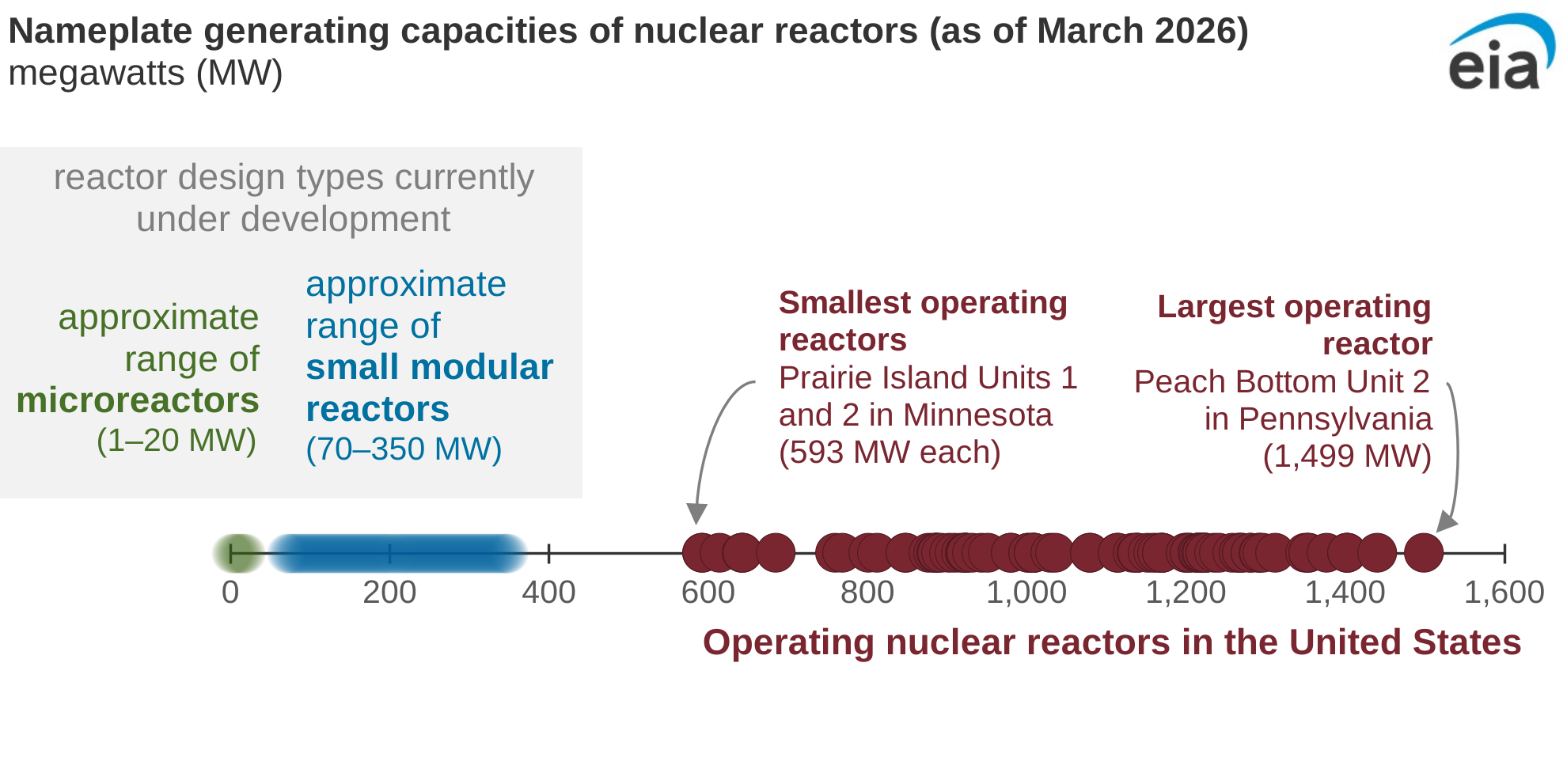
Note: Reactor generating capacity is nameplate capacity.
Electric utilities in the United States currently operate about 98 gigawatts (GW) of nuclear generating capacity, but very little nuclear capacity has been built in the last few decades. High capital costs and lengthy licensing and approval processes have limited the expansion of nuclear power. However, several companies are developing new small modular reactor (SMR) designs aimed at reducing capital costs and increasing siting flexibility, challenges associated with traditional nuclear power.
The generating capacity of a large-scale nuclear design typically ranges between 550 megawatts (MW) and 1,500 MW per unit; SMRs have a capacity of about 300 MW per unit or less. The main components of SMRs are modular, factory-assembled parts shipped to the plant construction site for installation, which could reduce construction times. Microreactors, a subset of SMRs, generally have a capacity of 20 MW or less and can operate as part of the electric grid, independently from the electric grid, or as part of a microgrid.
Aside from providing electricity to a power grid, SMRs and microreactors could provide power for applications where large plants are not needed or for sites that lack the infrastructure to support a large unit. SMRs are under consideration for powering AI, data centers, or other industrial activities where developers may not want or need to connect to the grid. SMRs could also service remote areas and communities that have high transmission and distribution costs.
SMR designs may employ light water as a coolant or other non-light water coolants such as gas, liquid metal, or molten salt. Several designs use high-assay low-enriched uranium (HALEU) fuel, which is uranium enriched between 5% and under 20% uranium-235, the main isotope that produces energy during a chain reaction. HALEU is more highly enriched than the sub 5% low-enriched uranium (LEU) fuel currently used in most nuclear reactors. The higher enrichment has a higher burnup, which could improve efficiency and performance, allow smaller reactor footprints, and reduce spent fuel waste.
We reviewed specifications for commercial SMR and microreactor designs under development in the United States as of February 2026 and have compiled the following tables:
Light water-cooled reactors
Light water-cooled SMR designs are typically smaller versions of existing large reactor designs that use the hydrogen in water as a moderator, which slows down neutrons to increase the likelihood of a fission event. In most cases, they are pressurized water reactors, use the type of low-enriched uranium fuel used in U.S. reactors today, and are intended to provide scalable baseload electricity to a traditional power grid.
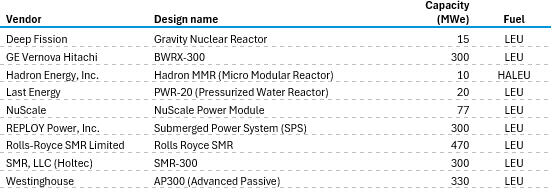
Note: MW=megawatts electricity; LEU=low-enriched uranium, enriched to less than 4.95%, standard in currently operating reactors in the United States; HALEU=high-assay low-enriched uranium (enrichment above 4.95% and below 20%)
High-temperature gas reactors
High-temperature gas reactor (HTGR) designs use graphite as a moderator and helium gas as a coolant. HTGRs are capable of operating at very high temperatures, which could make them suitable for powering industrial processes that require high heat inputs, such as thermochemical processes using electrolyzers for hydrogen production. Some HTGRs are designed to use HALEU and others are designed to use Tristructural Isotropic (TRISO) particle fuel, a fuel structure designed to be highly durable and withstand extreme temperatures that are well beyond the threshold of current nuclear fuels.
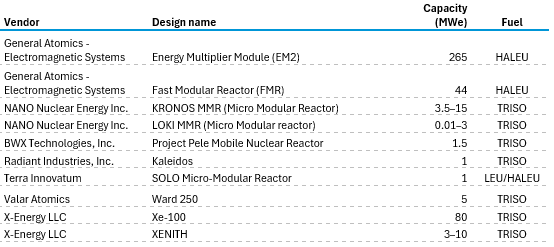
Note: MW=megawatts electricity; LEU=low-enriched uranium, enriched to less than 4.95%, standard in currently operating reactors in the United States; HALEU=high-assay low-enriched uranium (enrichment above 4.95% and below 20%)
Molten salt reactors
Molten Salt Reactor (MSR) designs use molten salts to serve as the reactor fuel and/or coolant. MSRs can generally be categorized as either a reactor with nuclear fuel dissolved in a molten salt or as a reactor using solid fuel with molten salt used as a coolant. When molten salts act as both fuel and coolant, a fissile material, such as uranium or plutonium, is dissolved directly into a molten fluoride or chloride salt coolant. They operate at high temperatures, and, like HTGRs, they can be used for electricity generation and heat generation for industrial processes.
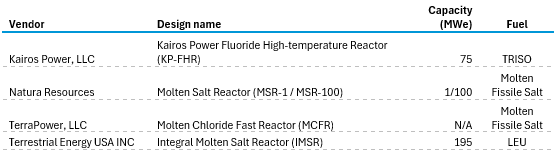
Note: MW=megawatts electricity; LEU=low-enriched uranium enriched to less than 4.95%, standard in currently operating reactors in the United States; TRISO=tristructural isotopic particle fuel fabricated from HALEU; Molten fissile salt=molten salted mixed with uranium 235, uranium 233, or plutonium
Sodium-cooled reactors
Sodium-cooled reactor (SCR) designs use liquid metal (sodium) as a coolant instead of light water that is typically used in operating nuclear reactors. These designs allow the reactor to operate at higher temperatures and lower pressures, potentially improving efficiency. They also potentially allow for a greater portion of the fuel to be used, or burned, inside the reactor vessel.
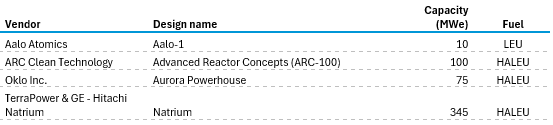
Note: MWe=megawatts electricity; LEU=low-enriched uranium enriched to less than 4.95%, standard in currently operating reactors in the United States; HALEU=high-assay low-enriched uranium (enrichment above 4.95%); TRISO=tristructural isotopic particle fuel fabricated from HALEU
Other designs
Vendors with designs not readily classified in the preceding categories are also engaged in pre-application activities with the Nuclear Regulatory Commission (NRC).

Note: MWe=megawatts electricity; LEU=low-enriched uranium enriched to less than 4.95%, standard in currently operating reactors in the United States; HALEU=high-assay low-enriched uranium (enrichment above 4.95%); TRISO=tristructural isotopic particle fuel fabricated from HALEU
Looking ahead
Federal government support for domestic SMR technology has increased. In March 2025, U.S. Department of Energy (DOE) reissued a tender for $900 million in federal funding to promote SMR development. In June 2025 DOE announced the Energy Reactor Pilot Program. The program aims to expedite the testing of advanced reactor designs authorized by the Department at sites that are located outside of the national laboratories. Applicants are responsible for funding their individual pilot reactor designs, but the program is intended to support further private funding and provide a fast-track approach to licensing. DOE has selected the following vendors for the program: Aalo Atomics Inc.; Antares Nuclear, Inc.; Deep Fission Inc.; Last Energy Inc.; Oklo Inc.; Natura Resources LLC; Radiant Industries Inc.; Terrestrial Energy Inc.; and Valar Atomics Inc.
The U.S. military is in the process of adopting commercial microreactors. In 2024, the Defense Innovation Unit with the Department of the Army and the Department of the Air Force launched the Advanced Nuclear Power for Installations program.
In April 2025, the following eligible vendors were named for the program: Antares Nuclear, Inc.; BWXT Advanced Technologies LLC; General Atomics Electromagnetic Systems; Kairos Power LLC; Oklo Inc.; Radiant Industries Inc.; Westinghouse Government Services; and X-Energy, LLC.
In October 2025, the Department of the Army announced the launch of the Janus Program, aimed at building microreactors. The Janus Program will build upon Project Pele, a transportable nuclear reactor intended for electricity production. The DOE laboratory, which worked on Project Pele, will also be working on the Janus Program.
As part of next steps for the Janus Program, the Department of the Army has selected nine bases to possibly site microreactors. These installations include Fort Benning, Fort Bragg, Fort Campbell, Fort Drum, Fort Hood, Fort Wainwright, Holston Army Ammunition Plant, Joint Base Lewis-McChord, and Redstone Arsenal.
The Department of the Air Force is planning its first nuclear microreactor at Eielson Air Force Base in Alaska, in a pilot program with Oklo, Inc., selected as the vendor for their sodium-cooled Aurora design reactor. The project will be commercially owned and operated and aims to deliver 1 MW to 5 MW of electricity by 2027.
The Department of the Navy has used advanced nuclear reactors to power aircraft carriers and submarines since the 1950s but is also soliciting offers for commercial on-site SMRs and microreactors to power its installations.
We have also compiled a list of advanced nuclear reactor designs currently under construction as pilots or demonstration projects as well as planned projects for future development.
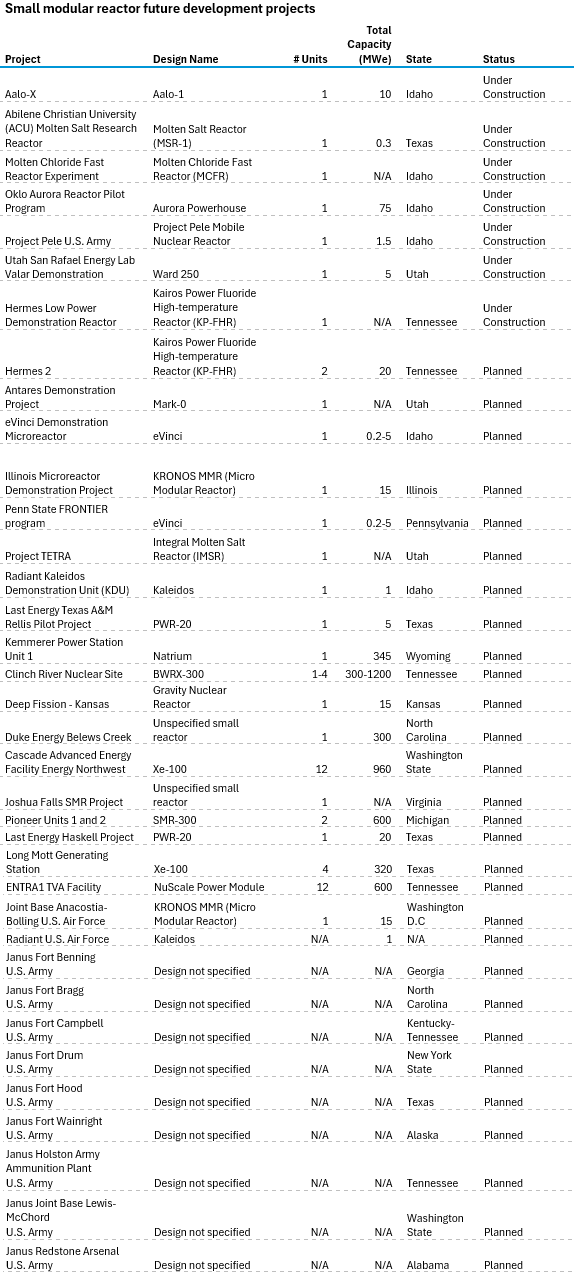
Lastly, the DOE Fuel Line Pilot Program supports the Energy Reactor Pilot Program and establishes a domestic nuclear fuel supply chain for testing new reactors. The program uses the DOE authorization process to build and operate nuclear fuel production and to provide a fast-tracked approach to commercial licensing.
Principal contributors: Slade Johnson, William Walsh