
U.S. Henry Hub natural gas price expected to increase from recent lows
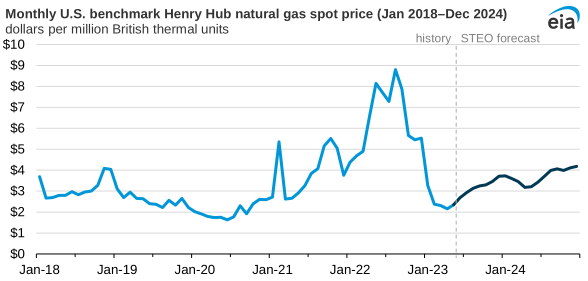
In our May Short-Term Energy Outlook (STEO), we expect the U.S. benchmark Henry Hub natural gas spot price to increase throughout 2023 from its recent lows. In April, the Henry Hub price averaged $2.16 per million British thermal units (MMBtu). We expect the monthly average Henry Hub price to reach $3.71/MMBtu in December. Forecast prices throughout the rest of the year remain much lower compared with last year, averaging $2.91/MMBtu for the year, a more than 50% decline from the 2022 average price of $6.42/MMBtu, according to our May STEO.
The Henry Hub spot price declined throughout the 2022–2023 winter due to mild temperatures in much of the Lower 48 states that reduced demand for natural gas for heating and resulted in less-than-average natural gas withdrawals from storage. U.S. dry natural gas production grew during this period, reaching a monthly average record in February 2023 of 101.5 billion cubic feet per day (Bcf/d). U.S. natural gas in storage was 19% above the previous five-year (2018–2022) average at the end of April, at 2,114 billion cubic feet (Bcf). We expect natural gas storage inventories to remain above their five-year averages throughout 2023, which contributes to our expectation of lower prices compared with last year.
Although we expect the Henry Hub price to average less than $4.00/MMBtu in 2023, we forecast natural gas prices will increase from their recent lows of close to $2.00/MMBtu as demand for natural gas increases. We forecast that natural gas consumed for U.S. electricity generation this summer (May–September) will average 38 Bcf/d, the second most on record behind last year. We also expect U.S. liquefied natural gas (LNG) exports to increase from the first-quarter average of 11.6 Bcf/d to 12.2 Bcf/d this summer. We forecast U.S. dry natural gas production to decline from recent highs to average 100.4 Bcf/d this summer.
Because of the increased demand and reduced production, we expect less natural gas to be injected into U.S. storage this summer, resulting in natural gas storage inventories that are closer to the five-year average. We expect inventories to end the injection season (April 1–October 31) 4% higher than the five-year average, at 3,762 Bcf.
Principal contributor: Corrina Ricker
Tags: prices, monthly, natural gas, Henry Hub