Menu
Crude oil, gasoline, heating oil, diesel, propane, and other liquids including biofuels and natural gas liquids.
Exploration and reserves, storage, imports and exports, production, prices, sales.
Sales, revenue and prices, power plants, fuel use, stocks, generation, trade, demand & emissions.
Energy use in homes, commercial buildings, manufacturing, and transportation.
Reserves, production, prices, employment and productivity, distribution, stocks, imports and exports.
Includes hydropower, solar, wind, geothermal, biomass and ethanol.
Uranium fuel, nuclear reactors, generation, spent fuel.
Comprehensive data summaries, comparisons, analysis, and projections integrated across all energy sources.
Monthly and yearly energy forecasts, analysis of energy topics, financial analysis, congressional reports.
Financial market analysis and financial data for major energy companies.
Greenhouse gas data, voluntary reporting, electric power plant emissions.
Maps, tools, and resources related to energy disruptions and infrastructure.
State energy information, including overviews, rankings, data, and analyses.
Maps by energy source and topic, includes forecast maps.
International energy information, including overviews, rankings, data, and analyses.
Regional energy information including dashboards, maps, data, and analyses.
Tools to customize searches, view specific data sets, study detailed documentation, and access time-series data.
EIA's free and open data available as API, Excel add-in, bulk files, and widgets
Come test out some of the products still in development and let us know what you think!
EIA's open source code, available on GitHub.
Forms EIA uses to collect energy data including descriptions, links to survey instructions, and additional information.
Sign up for email subscriptions to receive messages about specific EIA products
Subscribe to feeds for updates on EIA products including Today in Energy and What's New.
Short, timely articles with graphics on energy, facts, issues, and trends.
Lesson plans, science fair experiments, field trips, teacher guide, and career corner.
EIA is continuing normal publication schedules and data collection until further notice.
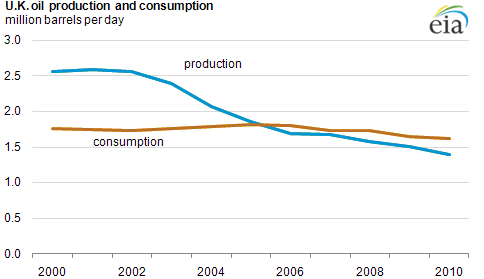
The United Kingdom (U.K.) is the largest producer of oil and second-largest producer of natural gas in the European Union. Due to steadily declining production since the early 2000s, the U.K. became a net importer of natural gas and oil in 2004 and 2005, respectively.
In 2010, the U.K. produced 1.4 million barrels per day (bbl/d) of oil and consumed 1.6 million bbl/d. While consumption remained relatively constant throughout the last decade, 2010 production declined 7% from 2009. Further declines are expected: the U.S. Energy Information Administration's Short-Term Energy Outlook predicts the U.K.'s production will fall to 1.2 million bbl/d in 2012. Despite decreasing production, the U.K. remains one of the European Union's leading petroleum exporters; in 2010, the U.K. exported 832,000 bbl/d, more than half of its total production.
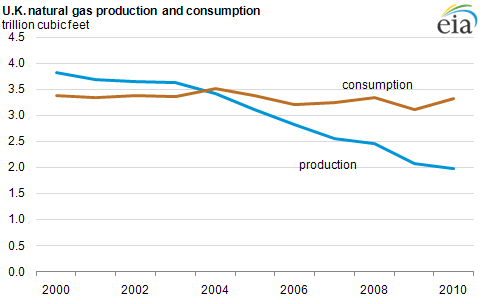
In 2010, U.K. natural gas production was 2.0 trillion cubic feet, a 5% drop from 2009, and the lowest level since 1992. Natural gas consumption rose 7% in 2010. To offset its declining natural gas production in the North Sea, the U.K. is importing more liquefied natural gas (LNG). Deliveries of LNG to the U.K. were up 0.86 billion cubic feet per day, or 54%, during the first nine months of 2011 compared to the same period in 2010.
Because discoveries of new oil and natural gas reserves have not outpaced the maturation of existing oil and natural gas fields, production from both has declined. The U.K.'s increasing reliance on imported natural gas and oil has spurred the government to develop energy policies to focus on enhanced oil and gas recovery, as well as increased cooperation with Norway—U.K.'s largest oil supplier. The U.K. has also invested heavily in renewable energy; according to the U.K. Department of Energy and Climate Change, the U.K. has the largest offshore wind resource in the world.
EIA's United Kingdom Country Analysis Brief features additional analysis of these trends, along with a broad discussion of the U.K.'s energy sector.
Tags: crude oil, exports/imports, international, liquid fuels, natural gas, offshore, oil/petroleum, production/supply, United Kingdom