
Before recent transfer, Highway Trust Fund had reached its lowest level in years
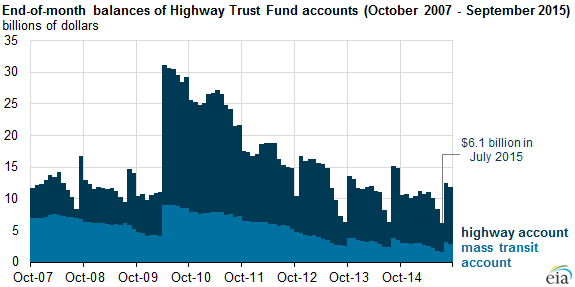
Earlier this year, the Highway Trust Fund (HTF) reached its lowest level in decades, ending July at $6.1 billion dollars. A congressionally approved transfer of more than $8 billion boosted the fund's balance to end the fiscal year (September 30) at $12 billion, but that is still the second-lowest year-end level since 1984.
Construction of the U.S. Interstate Highway System began in 1956. Extensions brought the total length of the system to 47,856 miles by 2013. Maintenance of this highway system and some new road construction is financed by the HTF, which receives revenue from taxes on gasoline and diesel fuel. Since 1982, the HTF has been divided into a highway account and a smaller mass transit account. As growth in the total number of road miles has slowed, outlays have generally been focused on maintenance.
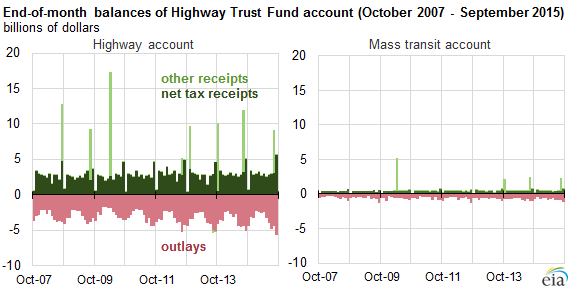
The balance of the HTF is based on the relative values of tax receipts, outlays, and transfers from other funding sources. Tax receipts are based on fuel consumption rather than driving distance, so as fuel economy improves, tax receipts may decline even as travel rises. From 2007 to 2011, highway travel itself declined, further reducing tax receipts, but since 2011 vehicle-miles traveled have increased. Over time, expenditures from the HTF have increased as the highway system expands and as it ages, because of higher maintenance requirements.
In the fiscal year that ended September 30, 2015, the average monthly net HTF tax receipt was about $3 billion, and the average monthly outlay was nearly $4 billion. With outlays exceeding receipts and HTF balances dwindling, Congress in July transferred $8 billion from other sources to ensure the fund's solvency. Before this transfer, the HTF was at $6.1 billion, the lowest monthly value in decades.
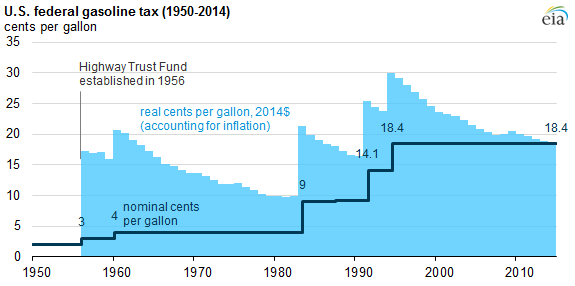
The federal gasoline tax has been raised only a few times since the Highway Trust Fund was created. The most recent gasoline tax increase was in October 1993, when it was set at 18.4 cents per gallon (¢/g). This fixed rate does not adjust for inflation or fluctuate as gasoline prices fluctuate. Of the 18.4 cents, 18.3 cents is an excise tax, and 0.1 cent is the leaking underground storage tank (LUST) tax. The United States has more than half a million underground storage tanks for petroleum products and hazardous substances, and the LUST fund was established to support efforts to prevent and remediate leaks from these tanks.
States and some local governments also levy fuel taxes. On average, state fuel taxes tend to be higher than federal fuel taxes, averaging 26¢/g for gasoline and 27¢/g for diesel. State gasoline and diesel taxes are highest in Pennsylvania (52¢/g for gasoline, 65¢/g for diesel) and lowest in Alaska (9¢/g for both). In September 2015, state and federal taxes made up about 19% of the retail price of gasoline and 21% of the retail price of diesel.
Principal contributor: EIA Staff
Tags: gasoline, taxes, transportation