U.S. Energy Information Administration logo
Skip to sub-navigation
January 26, 2022

Proved reserves of natural gas fell 4% in the United States during 2020

U.S. natural gas proved reserves

Because of lower natural gas prices in the first year of the COVID-19 pandemic, U.S. operators reported that proved natural gas reserves in 2020 declined by 4% to 473.3 trillion cubic feet (Tcf), according to our Proved Reserves of Crude Oil and Natural Gas in the United States, Year-End 2020 report.

Proved reserves are operator estimates of the volumes of oil and natural gas that geological and engineering data demonstrate with reasonable certainty to be recoverable in the future from known reservoirs under existing economic and operating conditions.

The decline in natural gas reserves in 2020 was largely attributable to lower natural gas prices. The average annual price of natural gas at Henry Hub fell from $2.56 per million British thermal units (MMBtu) in 2019 to $2.03/MMBtu in 2020.

In 2020, low prices caused many operators to revise their proved reserves estimates downward and scale back development plans for new wells. Higher natural gas prices in 2021 will likely lead to more proved natural gas reserves in 2021.
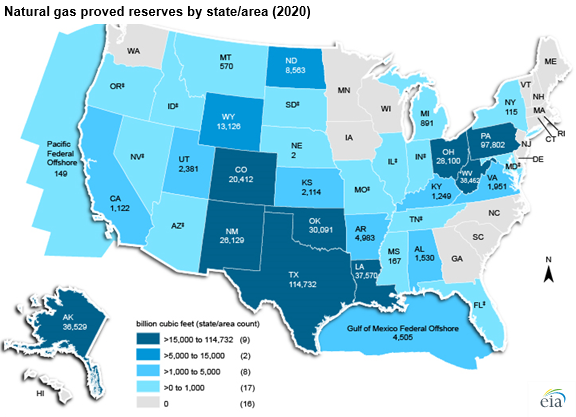
natural gas proved reserves by state/area
Source: U.S. Energy Information Administration, U.S. Crude Oil and Natural Gas Proved Reserves

Operators in Texas reported the largest decrease in natural gas proved reserves in 2020, down 11 Tcf, or 9%. Pennsylvania’s natural gas proved reserves fell by 9.6 Tcf, or 9%, in 2020.

In contrast, proved reserves of natural gas increased in Alaska from 9 Tcf to 36 Tcf. A large-scale liquefied natural gas development project received federal approval in May 2020. This project will include a new pipeline to bring natural gas from the north slope of Alaska to liquefaction and export facilities on its southern coast.
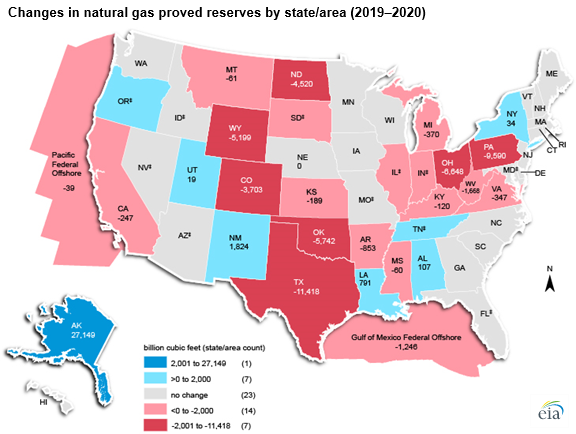
changes in natural gas proved reserves by state/area
Source: U.S. Energy Information Administration, U.S. Crude Oil and Natural Gas Proved Reserves

Principal contributor: Steve Grape

Statistics
Analysis
Tools
Education
News

Petroleum & Other Liquids

Crude oil, gasoline, heating oil, diesel, propane, and other liquids including biofuels and natural gas liquids.

Natural Gas

Exploration and reserves, storage, imports and exports, production, prices, sales.

Electricity

Sales, revenue and prices, power plants, fuel use, stocks, generation, trade, demand & emissions.

Coal

Reserves, production, prices, employment and productivity, distribution, stocks, imports and exports.

Nuclear & Uranium

Uranium fuel, nuclear reactors, generation, spent fuel.

Renewable & Alternative Fuels

Includes hydropower, solar, wind, geothermal, biomass and ethanol.

EIA Survey Forms

Forms EIA uses to collect energy data including descriptions, links to survey instructions, and additional information.

Total Energy

Comprehensive data summaries, comparisons, analysis, and projections integrated across all energy sources.

U.S. States

State energy information, including overviews, rankings, data, and analyses.

International

International energy information, including overviews, rankings, data, and analyses.

Environment

Greenhouse gas data, voluntary reporting, electric power plant emissions.

Data Tools, Apps, & Maps

Tools to customize searches, view specific data sets, study detailed documentation, and access time-series data.

Open Data

EIA's free and open data available as API, Excel add-in, bulk files, and widgets

EIA Beta

Come test out some of the products still in development and let us know what you think!

Open Source Code

EIA's open source code, available on GitHub.

RSS Feeds

Subscribe to feeds for updates on EIA products including Today in Energy and What's New.