
Projected CO2 emissions vary with coal and nuclear power plant retirements
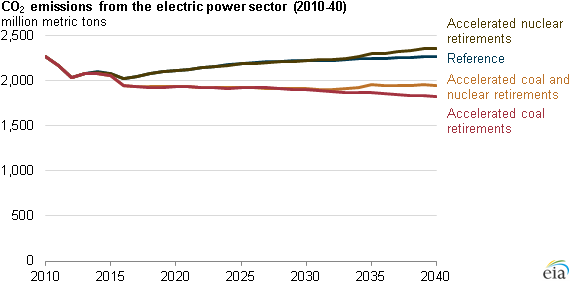
Significant retirements of nuclear and coal power plants in the United States could change the amount of carbon dioxide (CO2) emitted by the electric power sector. EIA's Annual Energy Outlook 2014 (AEO2014) features several accelerated retirements cases that represent conditions leading to additional coal and nuclear plant retirements in order to examine the potential energy market and emissions effects of the loss of this capacity. CO2 emissions are significantly reduced when compared to the Reference case in side cases with accelerated coal retirements. CO2 emissions increase slightly in the Accelerated Nuclear Retirements case. Natural gas and renewables are the primary replacements for lost capacity in each scenario.
How does EIA project nuclear retirements?
The AEO2014 Accelerated Nuclear Retirements case reflects uncertainty regarding continued operation of the existing nuclear fleet. While the Reference case assumes that all nuclear plants will continue to operate if they are economic through 2040, the Accelerated Nuclear Retirements case assumes that they will retire after their 60th year of operation. The Nuclear Regulatory Commission has the authority to issue initial operating licenses for commercial nuclear power plants for a period of 40 years, after which 20-year incremental renewals are possible. Approximately 75% of the U.S. generating fleet has already received an initial 20-year license extension, and AEO2014 assumes that the remaining plants also receive extensions. Operators are preparing applications for license renewals that would allow operation beyond 60 years.
Coal (74%) and natural gas (24%) power plants accounted for almost all of the CO2 emitted by the electric power sector in 2012. Nuclear power and renewables do not emit CO2.
The Accelerated Nuclear Retirements case projects CO2 emissions that are 4% higher compared with the Reference case in 2040. In this side case, natural gas-fired generation is projected to be 13% higher than in the Reference case. However, renewables generation in the Accelerated Nuclear Retirements case increases 5% relative to the Reference case, which moderates the emissions impact. Coal generation does not differ significantly between the two cases.
Like in the Accelerated Nuclear Retirements case, natural gas generation makes up for most of the lost capacity in the Accelerated Coal Retirements case, resulting in a 19% increase in natural gas generation relative to the Reference case in 2040. However, because generation using natural gas emits less CO2 than coal, emissions decrease by 20% relative to the Reference case over that period. A 10% increase in renewable generation relative to the Reference case also serves to lower overall emissions.
Emissions are slightly higher in the combined Accelerated Coal and Nuclear Retirements case than in the Accelerated Coal Retirements case, because natural gas-fired generation replaces some nuclear power generation. However, the effect of the coal-fired capacity retirements keeps emissions 14% below the Reference case level in 2040.
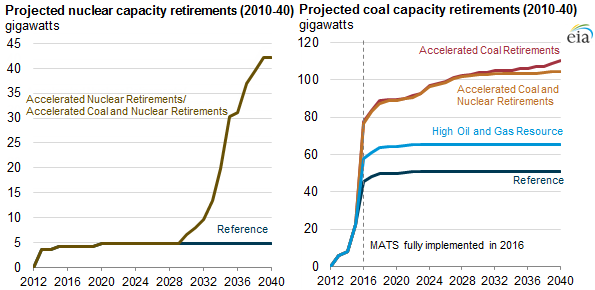
Note: MATS is Mercury and Air Toxics Standards.
The coal and nuclear retirements resulting from each case examined are shown in the graphs above. Natural gas-fired combined-cycle units are favored sources of new capacity in all cases examined because of competitive fuel prices and relatively moderate capital costs. Renewable capacity is also added, primarily as a result of state renewable portfolio standards (RPS) and federal tax incentives early in the projection and increased economic competitiveness towards the end of the projection in all cases.
The AEO2014 Issues in Focus article includes a description of the underlying assumptions driving the cases discussed, and an examination of the resulting effects on the electricity generation mix, electric generating capacity additions, natural gas prices, and retail electricity prices.
Principal contributor: Michael Leff
Tags: CO2 (carbon dioxide), coal, electricity, emissions, generation, natural gas, nuclear