
China, the United States, and Japan hold most strategic oil inventories in 2025
Note: Other estimates derived from the International Energy Agency, China National Bureau of Statistics, Vortexa Analytics, Kayrros, Kpler, Argus Media, and Global Trade Tracker.
In the 1970s, the United States and other OECD countries established strategic oil stocks aimed at mitigating the impact of supply disruptions. In March 2026, the United States, along with other members of the International Energy Agency, agreed to a coordinated emergency release of strategic oil stocks following the effective closure of the Strait of Hormuz.
In this article, we examine strategic global oil inventory levels as of December 2025, before the coordinated emergency release. We plan to update our assessment of inventories periodically in our Short-Term Energy Outlook beginning in May 2026.
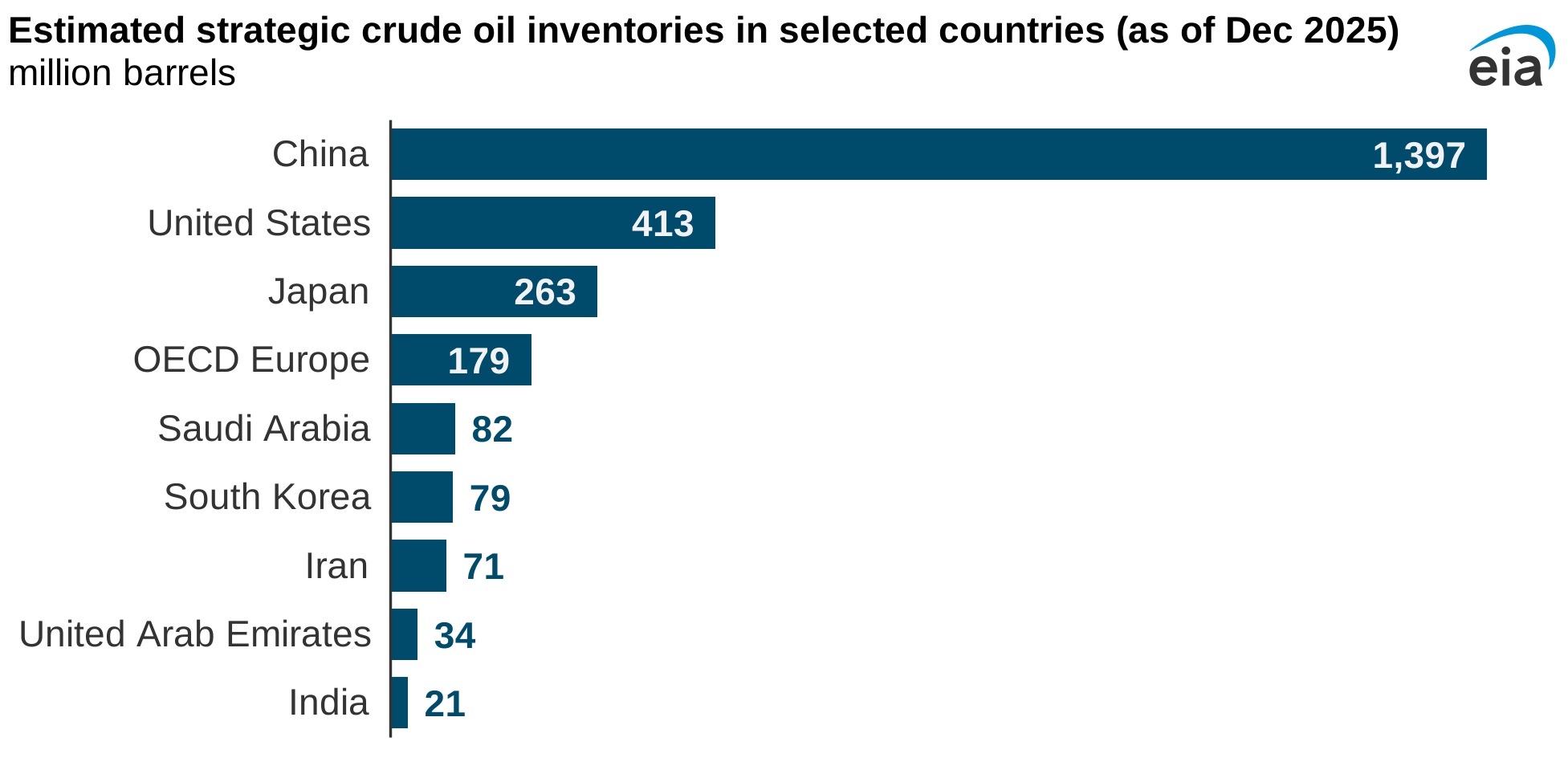
We estimate that as of December 2025, the three largest strategic oil inventories were held by China, which added large volumes to its strategic oil inventories in 2025; the United States; and Japan. Other significant strategic inventories are held by countries in OECD Europe, the Middle East, and Asia.
Given the lack of transparent data on strategic inventories in most countries, we take a conservative approach in estimating these volumes. For countries without a specified strategic petroleum reserve, we define strategic inventories as those owned by governments or national oil companies (NOCs) and, for a few countries, only inventories held in on-land storage. In addition, we do not include inventories in commercial, floating, or underground storage facilities, except for in China, for which we define strategic inventories as including commercial inventories. While some countries, like Japan, also require companies to hold barrels in commercial inventories for strategic purposes, we only include government-owned inventories or those held by government-owned NOCs for this estimation.
We also limit our analysis to the 10 countries with the largest estimated current strategic oil inventories and on-land storage capacity, which together equal about 70% of global totals. These estimates do not take into account the coordinated emergency release in March 2026 by member countries of the International Energy Agency following Iran’s de facto closure of the Strait of Hormuz.
United States
The U.S. Strategic Petroleum Reserve (SPR), established in December 1975, has a full storage capacity of 714 million barrels of crude oil. In December 2025, the SPR held 413 million barrels. SPR stocks increased to more than 415 million barrels in March, ahead of the coordinated release, and were about 409 million barrels as of April 10, 2026.
The SPR is separate from the more than 400 million barrels of commercial crude oil inventories in the United States.
China
We estimate that China added an average of 1.1 million barrels per day of crude oil to strategic oil inventories in 2025, which reached nearly 1.4 billion barrels as of December 2025. Prior to the Iran conflict, preliminary government data indicate that China has continued building inventories in 2026.
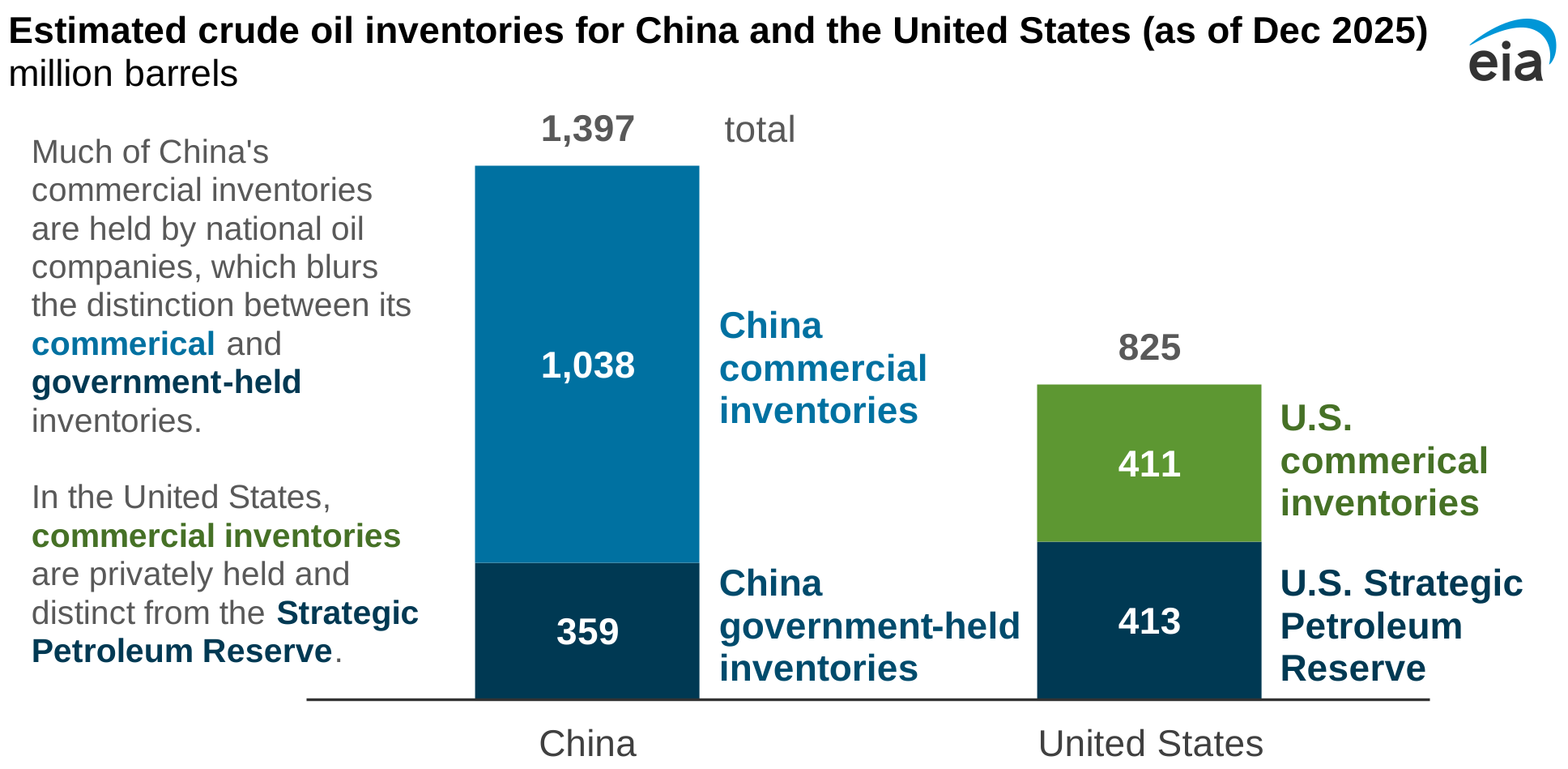
China does not report data on its oil inventories, so we estimated China’s inventories based on imports, exports, refining, and oil inventory data from third-party and official sources. For this analysis, we consider both China’s government-held and commercial inventories to be part of strategic oil inventories, based on reports that China’s NOCs have been directed since 2024 to add emergency oil to commercial stockpiles, which effectively act as a second source of strategic inventories.
Note: Other estimates derived from the International Energy Agency, China National Bureau of Statistics, Vortexa Analytics, Kayrros, Kpler, Argus Media, and Global Trade Tracker.
While we assume that both commercial and government-held crude oil inventories in China are part of strategic oil inventories, we estimate that government-held inventories in China averaged about 360 million barrels in December 2025, which is similar to the U.S. SPR level of nearly 414 million barrels during the same time period. Commercial crude oil inventories in China, which include inventories held at refineries, have grown to an estimated 1 billion barrels as of December 2025, compared with 411 million barrels held commercially in the United States.
OECD Asia and Europe
Japan holds the third-largest strategic oil inventories, reaching 263 million barrels in government-held inventories as of December 2025. These figures do not include international joint stockpiling inventories or commercial inventories held for strategic purposes pursuant to Japanese law. Japan’s Oil Stockpiling Act requires industry to hold 70 days of demand—approximately 220 million barrels—in addition to the 90-day strategic reserve overseen by the government.
According to the International Energy Agency, OECD Europe held an estimated 179 million barrels in government inventories as of December 2025.
South Korea also holds substantial strategic oil inventories, averaging 79 million barrels during the same period in 2025.
Other non-OECD countries
Apart from India, strategic inventory levels for the non-OECD countries included in our analysis (Saudi Arabia, the UAE, and Iran) are difficult to determine. It is also difficult to distinguish between storage facilities used for commercial and strategic purposes. Given these limitations, we estimate current strategic inventories for Saudi Arabia, UAE, and Iran based on the December 2025 average refinery and commercial inventories reported by Vortexa and Kpler.
Saudi Arabia held an average of 82 million barrels in on-land storage as of December 2025. These estimates do not include inventories reportedly held by Saudi Arabia in leased crude oil storage sites in South Korea and in Okinawa and the Kiire terminal in Japan.
The UAE held an average of 34 million barrels of on-land oil inventories as of December 2025. The UAE also maintains substantial underground storage in Fujairah, the capacity and inventory of which is unknown, and is seeking to increase storage capacity at the location. The UAE also reportedly leases storage sites at the Yeosu port in South Korea, the Kiire terminal in Japan, and the Mangalore storage facility in India.
Iran held an average of 71 million barrels of on-land oil as of December 2025. Iran reportedly holds crude oil in bonded storage in China, although its current inventory levels are unknown and not estimated here.
According to Indian Strategic Petroleum Reserve Ltd. (ISPRL), India had 21.4 million barrels of crude oil stored in its SPR as of March 2025.
India also had an additional 3 million barrels of crude oil stored at its Mangalore site for the Abu Dhabi National Oil Company (ADNOC) that is not considered part of India’s strategic reserve. An agreement between ADNOC and ISPRL allows ADNOC to use the site for commercial storage as long as 50% of capacity (approximately 6 million barrels) is available for ISPRL’s strategic use. India has also been exploring the possibility of adding storage outside of the country for its own oil and held discussions with Oman about leasing space to store 5 million barrels last year.
Principal contributors: Sean Hill, Eric Han, Jonathan Russo