
Energy products are key inputs to global chemicals industry
Note: Dollar values are expressed in 2010 U.S. dollars, converted based on purchasing power parity.
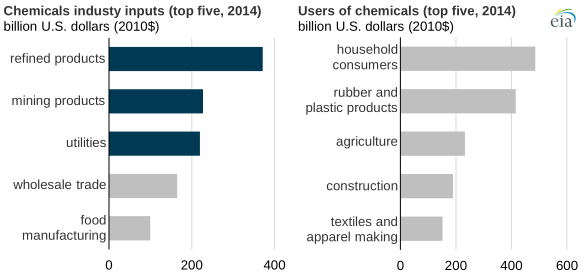
The industrial sector of the worldwide economy consumed more than half (55%) of all delivered energy in 2018, according to the International Energy Agency. Within the industrial sector, the chemicals industry is one of the largest energy users, accounting for 12% of global industrial energy use. Energy—whether purchased or produced onsite at plants—is very important to the chemicals industry, and it links the chemical industry to many parts of the energy supply chain including utilities, mines, and other energy product manufacturers.
The chemicals industry is often divided into two major categories: basic chemicals and other chemicals. Basic chemicals are chemicals that are the essential building blocks for other products. These include raw material gases, pigments, fertilizers, plastics, and rubber. Basic chemicals are sometimes called bulk chemicals or commodity chemicals because they are produced in large amounts and have relatively low prices. Other chemicals—sometimes called fine or specialty chemicals—require less energy to produce and sell for much higher prices. The category of other chemicals includes medicines, soaps, and paints.
The chemicals industry uses energy products such as natural gas for both heat and feedstock. Basic chemicals are often made in large factories that use a variety of energy sources to produce heat, much of which is for steam, and for equipment, such as pumps. The largest feedstock use is for producing petrochemicals, which can use oil-based or natural-gas-based feedstocks.
In terms of value, households are the largest users of chemicals because they use higher value chemicals, which are often chemicals that help to improve standards of living, such as medicines or sanitation products. Chemicals are also often intermediate goods—materials used in the production of other products, such as rubber and plastic products manufacturing, agricultural production, construction, and textiles and apparel making.
Note: Dollar values are expressed in 2010 U.S. dollars, converted based on purchasing power parity.
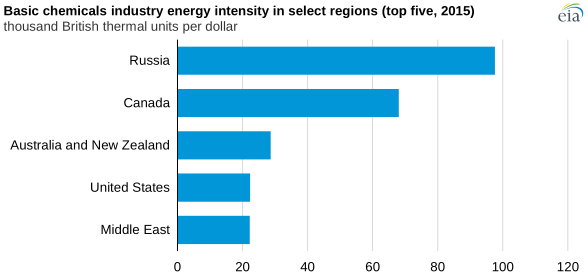
The energy intensity of the basic chemicals industry, or energy consumed per unit of output, is relatively high compared with other industries. However, the energy intensity of the basic chemicals industry varies widely by region, largely based on the chemicals a region produces. According to EIA’s International Energy Outlook 2018, Russia had the most energy-intensive basic chemicals industry in 2015, with an average energy intensity of approximately 98,000 British thermal units (Btu) per dollar, followed by Canada with an average intensity of 68,000 Btu/dollar.
The Russian and Canadian basic chemicals industries are led by fertilizers and petrochemicals. Petrochemicals and fertilizers are the most energy intensive basic chemicals, all of which rely on energy for breaking chemical bonds and affecting the recombination of molecules to create the intended chemical output. These countries produce these specific basic chemicals in part because they also produce the natural resources needed as inputs, such as potash, oil, and natural gas.
By comparison, the energy intensity of the U.S. basic chemical industry in 2015 was much lower, at 22,000 Btu/dollar, because the industry in the United States has a more diverse production mix of other basic chemicals, such as gases and synthetic fibers. However, EIA expects that increasing petrochemical development in the United States will increase the energy intensity of the U.S. basic chemicals industry.
The United States exports chemicals worldwide, with the largest flows to Mexico, Canada, and China. According to the World Input-Output Database, U.S. exports of all chemicals in 2014 were valued at $118 billion—about 6% of total U.S. exports—the highest level in decades.
Principal contributor: Elizabeth Sendich
Tags: industrial, consumption/demand