U.S. Energy Information Administration logo
Skip to sub-navigation
July 14, 2015

Summer gasoline prices are lowest in years
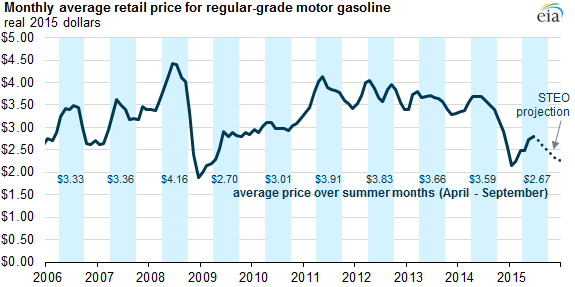
graph of monthly average regular grade motor gasoline retail price, as explained in the article text
Source: U.S. Energy Information Administration, Short-Term Energy Outlook Real prices viewer

The average retail price for motor gasoline this summer (April through September) is expected to be $2.67 per gallon, the lowest price (in real dollars, meaning adjusted for inflation) since 2009, based on projections in EIA's July Short-Term Energy Outlook (STEO). This decline is mainly the result of the projected 41% year-over-year decline in the average price of North Sea Brent crude oil.

Travel and gasoline consumption are expected to be higher this summer compared to levels in 2014. Motor gasoline consumption is expected to increase by 194,000 barrels per day (b/d), up 2.1% from last summer, reflecting higher real disposable income, substantially lower retail motor gasoline prices, and higher employment and consumer confidence.
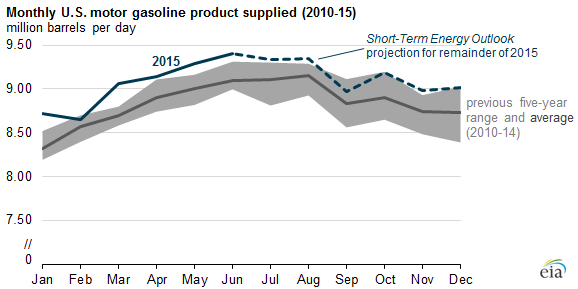
graph of monthly U.S. motor gasoline product supplied, as explained in the article text
Source: U.S. Energy Information Administration, Short-Term Energy Outlook July 2015 edition

Driving this summer (as measured by vehicle miles traveled) is expected to be 2.2% higher than last summer, the largest year-over-year summer increase in 11 years. The increase in highway travel is not just a response to the drop in gasoline prices. Real disposable income is projected to be 3.6% higher than last summer, the largest year-over-year increase in nine years. Nonfarm employment is projected to rise 2.1%, the largest such increase since 2000.

EIA uses product supplied, which reflects refinery and blender output, inventory change, and net imports, as a proxy for consumption. Growth in net refinery and blender output of motor gasoline is projected to slightly exceed that of consumption, increasing by 208,000 b/d. Primary inventories of finished motor gasoline and gasoline blending components began the summer season 10.7 million barrels above the previous five-year average, and are expected to end the season 3.7 million barrels above the previous five-year average. The projected 14.3 million barrel draw on gasoline inventories this summer compares with an 8.4 million barrel draw last summer. The increase in production and larger inventory draw contribute to an expected 62,000 b/d decline relative to last summer in the net imports of motor gasoline and blending components.

Principal contributors: Michael Morris, Tancred Lidderdale

Statistics
Analysis
Tools
Education
News

Petroleum & Other Liquids

Crude oil, gasoline, heating oil, diesel, propane, and other liquids including biofuels and natural gas liquids.

Natural Gas

Exploration and reserves, storage, imports and exports, production, prices, sales.

Electricity

Sales, revenue and prices, power plants, fuel use, stocks, generation, trade, demand & emissions.

Coal

Reserves, production, prices, employment and productivity, distribution, stocks, imports and exports.

Nuclear & Uranium

Uranium fuel, nuclear reactors, generation, spent fuel.

Renewable & Alternative Fuels

Includes hydropower, solar, wind, geothermal, biomass and ethanol.

EIA Survey Forms

Forms EIA uses to collect energy data including descriptions, links to survey instructions, and additional information.

Total Energy

Comprehensive data summaries, comparisons, analysis, and projections integrated across all energy sources.

U.S. States

State energy information, including overviews, rankings, data, and analyses.

International

International energy information, including overviews, rankings, data, and analyses.

Environment

Greenhouse gas data, voluntary reporting, electric power plant emissions.

Data Tools, Apps, & Maps

Tools to customize searches, view specific data sets, study detailed documentation, and access time-series data.

Open Data

EIA's free and open data available as API, Excel add-in, bulk files, and widgets

EIA Beta

Come test out some of the products still in development and let us know what you think!

Open Source Code

EIA's open source code, available on GitHub.

RSS Feeds

Subscribe to feeds for updates on EIA products including Today in Energy and What's New.