
Adoption of ENERGY STAR equipment varies among appliances
Note: Product types shown are not comprehensive of the ENERGY STAR program.
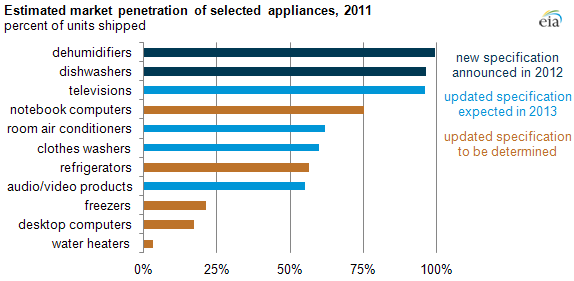
Appliances with the ENERGY STAR® logo are intended to represent more-efficient options in the marketplace. The adoption of this more-efficient equipment can vary significantly from one product type to the next. In 2011, almost all televisions and dishwashers available in stores were ENERGY STAR products, while few water heaters had the ENERGY STAR label.
ENERGY STAR, a joint program of the U.S. Environmental Protection Agency (EPA) and the U.S. Department of Energy, has existed since the early 1990s as a voluntary, market-based program identifying energy-efficient products. The intention is to identify the top 25% most-efficient options within a product class at the date the specification goes into effect. Over time, market penetration of ENERGY STAR-labeled appliances often increases, and when the market becomes well-saturated with ENERGY STAR devices, the specifications are typically updated.
In the case of dehumidifiers and dishwashers, market penetration was over 95% in 2011, so new specifications were announced and made effective in 2012. Similarly, televisions, room air-conditioners, clothes washers, and audio/video products will have updated specifications in 2013. Water heaters, on the other hand, are relatively new to the ENERGY STAR program and have little market penetration because there are specifications for some, but not all, water heater types. Electric storage tank and electric tankless (instantaneous) water heaters cannot earn the ENERGY STAR label because of limited energy savings potential. However, electric-powered heat pump water heaters can earn the label.
Specifications can also be revised in response to technological developments that allow greater efficiency without significant additional cost, or in response to federal efficiency standards, which also affect the marketplace by eliminating the least-efficient options.
Specifications of certain products are revised much more often than others. Televisions, which currently have no federal efficiency standard, have almost always had high market penetration of ENERGY STAR devices. Since the first television specification in the late 1990s, ENERGY STAR levels have been updated several times; version 6.0 of the specifications becomes effective in June 2013.
Some states and utilities offer incentives to increase adoption of ENERGY STAR products. For instance, Oregon and New Jersey have offered rebates for certain ENERGY STAR products, while states like North Carolina and Missouri have provided a sales tax holiday for some products.
Lists of ENERGY STAR products can be found on the ENERGY STAR website.